Measuring Miyazaki's Masterpieces
Who is the greatest creative in animation? Was it Walt Disney himself? Or was it one of Disney’s Nine Old Men, the workmen that actually brought the classic characters to vivid life? Well, we can see that the world’s revealed preference has been for more modern fare. Is it one of the new auteurs exploring frontiers in genre? Makoto Shinkai, Hideaki Anno, Shinichirō Watanabe, Satoshi Kon? Is it one of the gang behind Pixar’s legendary initial run? John Lasseter, Pete Docter, Andrew Stanton, Brad Bird?
Scroll through the wikipedia bios of any one of the still living titans and you’ll see the same name cited as an inspiration over and over again. Your favorite animator’s favorite animator. Hayao Miyazaki. The undisputed master, an unmistakable narrative and aesthetic voice, a director and writer who also finds time to hand-draw thousands of frames in his own films. The founder of a studio that has the strongest international brand in Japanese animation. And he just doesn’t know when to quit. Most of his greatest work was published in the latter half of his career, after he first announced his retirement in the 1990s! Now well into his eighties, he is purportedly still showing up at the studio every day and working on ideas. I am convinced he is like a shark. If he stopped drawing, he would stop breathing.
His six decades of relentless work have yielded a surprisingly digestible filmography: only 12 films, if we ignore all the others at Ghibli he wrote or produced or assisted but did not direct (many of which still bear his fingerprints) and focus on the intentional acts of auteurship1. When a delicious juicy burger is set in front of me, my least favorite thing is to discover that it has been stacked so high that I can’t wrap my mouth around it. Miyazaki’s filmography is the perfect size, not too daunting to tackle but not too slim to satiate. I feel this way about a lot of high profile creators, they’re both too prolific and too uneven to truly be iconic, drowning their more acclaimed output in a torrent of mid. Still, I prefer slim to stuffed. Better to be My Bloody Valentine than Snoop Dogg. With Miyazaki, you don’t have to choose! Every film he put his name on is magnificent, even the worst of them.
Eras
Shakespeare famously produced three types of plays: comedies, tragedies, and histories. But near the end of his career his works started taking on a new tenor, one more difficult to characterize. They were fascinated with the mystical and spectacular, they featured adventure and peril, they lack the humor of a comedy but often still have an optimistic ending. Scholars call these his “romances”: The Tempest, The Winter’s Tale, Cymbeline, etc.
I think Miyazaki similarly has a later era in his career, but it spans about half of his entire output. Early Miyazaki is typified by fantastical and European-inflected settings, the use of firearms, no CGI, low international presence, lower budgets and box office numbers, parallel work on Miyazaki’s Nausicaä manga, and Yoshifumi Kondō’s animation. Late Miyazaki comes with Miyazaki’s first—of many—retirement announcements and represents a passing of the torch from Miyazaki’s old Toei compatriots to young talent who grew up on Ghibli, typified by the use of CGI and digital ink, international distribution by Disney and GKIDS, worldwide recognition and renown, high production values with grueling development cycles, more grounded Japanese settings, no guns, and sharper yet subtler political critique of Japan in particular.
These rules do not hold fast, of course. Totoro is a grounded Japanese setting instead of European, Totoro and Kiki have no guns, Howl’s Moving Castle has a lot of aspects that feel more Early Miyazaki (fantastical European setting with a needless war). But the categories generally ring true. There is of course the enigma of Princess Mononoke, which sits right at the pivot between the two eras. It was the final film before Miyazaki’s first retirement, Kondō was the animation director, it features (primitive) firearms and a pointless war against nature reminiscent of Nausicaä, all of these point to it being Early Miyazaki. Yet it was internationally distributed by Miramax, boasted an enormous scale and budget, made big bucks at the box office, utilizes some CGI and digital ink, and features prominent Japanese aesthetics. And it just feels different than any other film before or since. It has graphic violence, a downer ending, and the only case of deceptively sympathetic characters turning two-faced, which imbues the plot with a much more angry and cynical view of humanity than the usual Ghibli optimism. It is best understood as the transitional work between the two eras, though in general I tend to group it with Late Miyazaki just so we get an even 6-6 split.
There are of course other ways you can choose to group these films e.g. from juvenile (Totoro, Ponyo) to mature (Mononoke, Nausicaä), or stories where the main verb is flying (Kiki, Castle in the Sky, The Wind Rises, Porco Rosso, Nausicaä). But I like this chronological framing because it invites us to try to get into the auteur’s head and understand how his priorities shift over time.
That being said, I am not going to be presenting them chronologically. I am going to be ranking them!
The Ranking
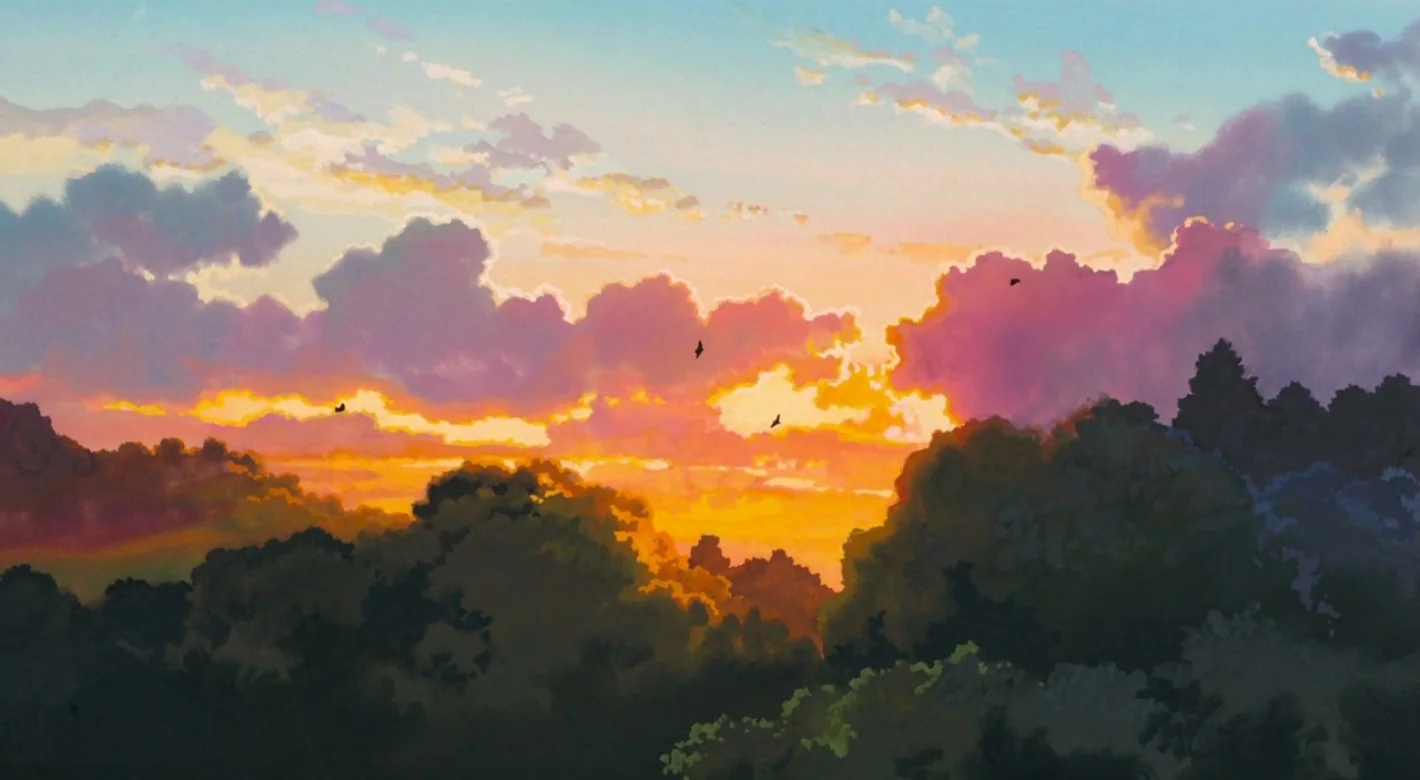 12. My Neighbor Totoro
It may seem sacrilegious to you that I am rating Totoro all the way at the bottom, but hey, something had to go here! It is still—like every Miyazaki film—a worthwhile piece of gorgeous animation and a clear labor of love. It also spawned the merch phenomenon that secured Ghibli’s financial solvency for decades to come. Without the insane international appeal of the rotund Totoro, would we have ever even made it to the spectacular scale of Late Miyazaki? For that I am grateful. I bow in gratitude to Totoro just as the little girls bow to the camphor tree.
What Totoro does well is inhabit the world of a child. Satsuki and Mei are painfully believable renditions of little girls, saddled with just the right concerns and behaviors with that age. As the uncle to many a niece I give these characters the Official Uncle Sam Seal of Approval. In the manner of the child they seem to be coping with their mother’s illness just fine until they suddenly aren’t, when a tiny change of plans sets them off and unearths their buried anxieties in a chorus of sobs and shrieks.
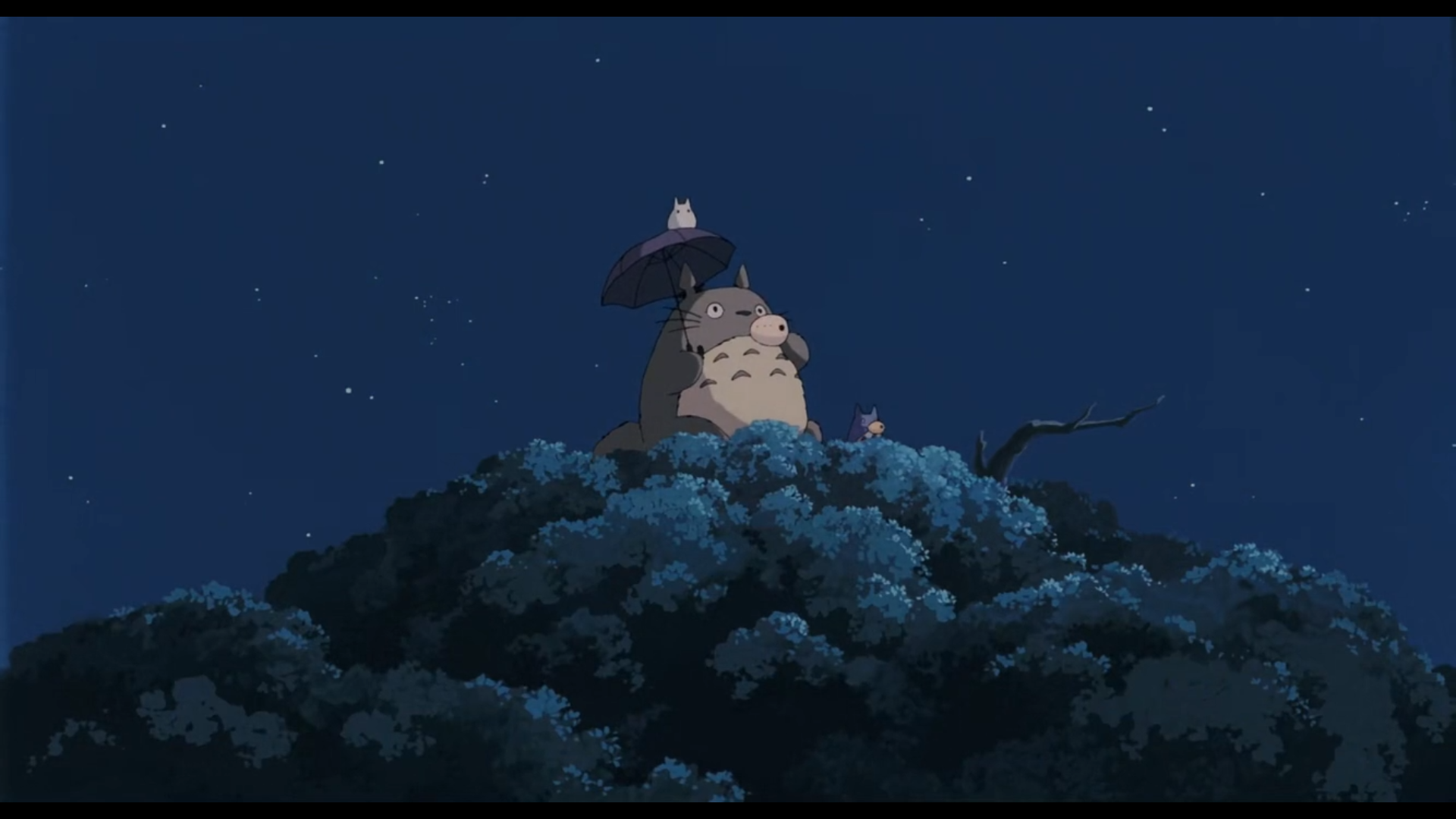
My issue here is that it takes about 60 minutes for the conflict to finally rear its head. Spirited Away zags wherever Totoro zigs. Chihiro’s parents are aloof and insensitive to her emotions, so the Kusakabe parents are extremely understanding and plugged in to their daughters’ needs. The spirits of the bathhouse are dangerous and unpredictable, so Totoro is harmless and altruistic. These decisions in Spirited Away are sources of conflict and peril, imbuing the moment to moment action with a sense of momentum. In Totoro the only real conflict is the strange confrontation with the soot sprites that doesn’t go anywhere and then Mei’s disappearance at the end. Even Kiki—the other cozy G-rated Early Miyazaki flick—has stakes in every scene. Kiki might fail the delivery and upset a customer! Here we’re mostly just treated to scenes of kids at play, which—while shockingly realist and totally cute—don’t really do it for me.
These plot issues could have been solved with some very slight tweaks. The heart of the matter is that our protagonists are too safe: their dad is too nice, their mom is on the mend, Totoro is awesome, their new community is supporting them. By tugging at the edges here we can introduce some genuine conflict: maybe their mom isn’t doing well, maybe she’s declining, maybe their dad is floundering at single parenting, maybe Totoro doesn’t trust them. You wouldn’t have to do all of them, but just pressing on some of those themes could maybe plant the seeds of doubt in the viewer that makes one wonder if Totoro himself is just an escapist fantasy for the girls to cope with their anxieties, until something undeniably supernatural occurs at the end. I think that would be a more satisfying watch.2
The scenery is beautiful as always, but also a little safe and repetitive. Boy and the Heron and The Wind Rises showed that Ghibli can do a much richer take on rural Japan. The soundtrack is a banger but totally underutilized, the main theme associated with Totoro is soaked in mystery and wonder but it doesn’t get the center stage it deserves. The titular spirit is of course the best part and kids will love him, but he gets surprisingly little screentime in his own film (only four scenes by my count, equivalent to the number of food scenes and mom scenes).
I can’t believe it gets rated as the best Ghibli film by some people, that’s just crazy. If I was feeling mean I’d suggest that maybe they prefer being cozy to being challenged3, but I’m willing to accept I’m missing something there. Maybe I’ve simply lost my sense of childlike wonder and demand unnecessary stuff like “conflict” from my stories.
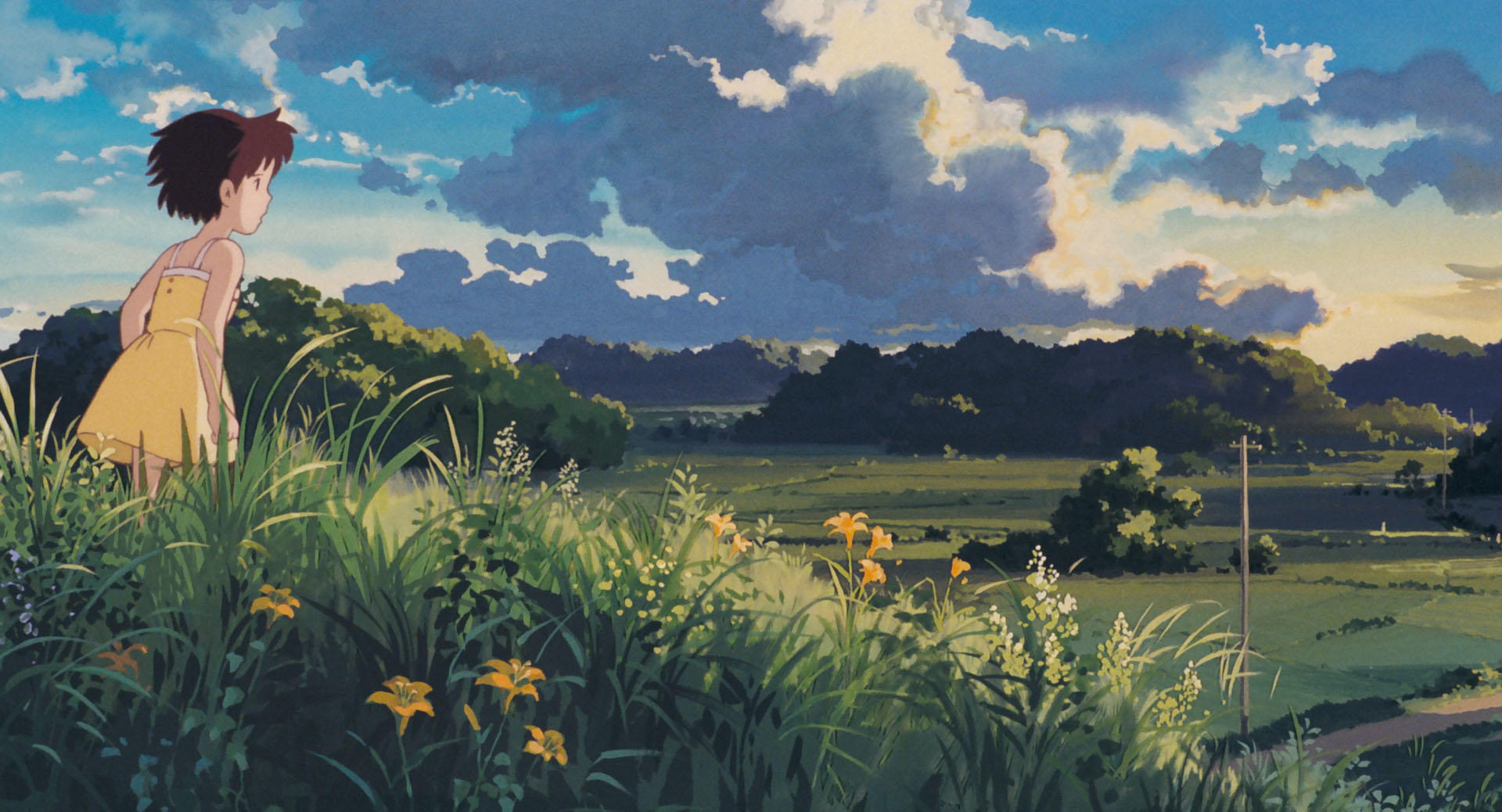
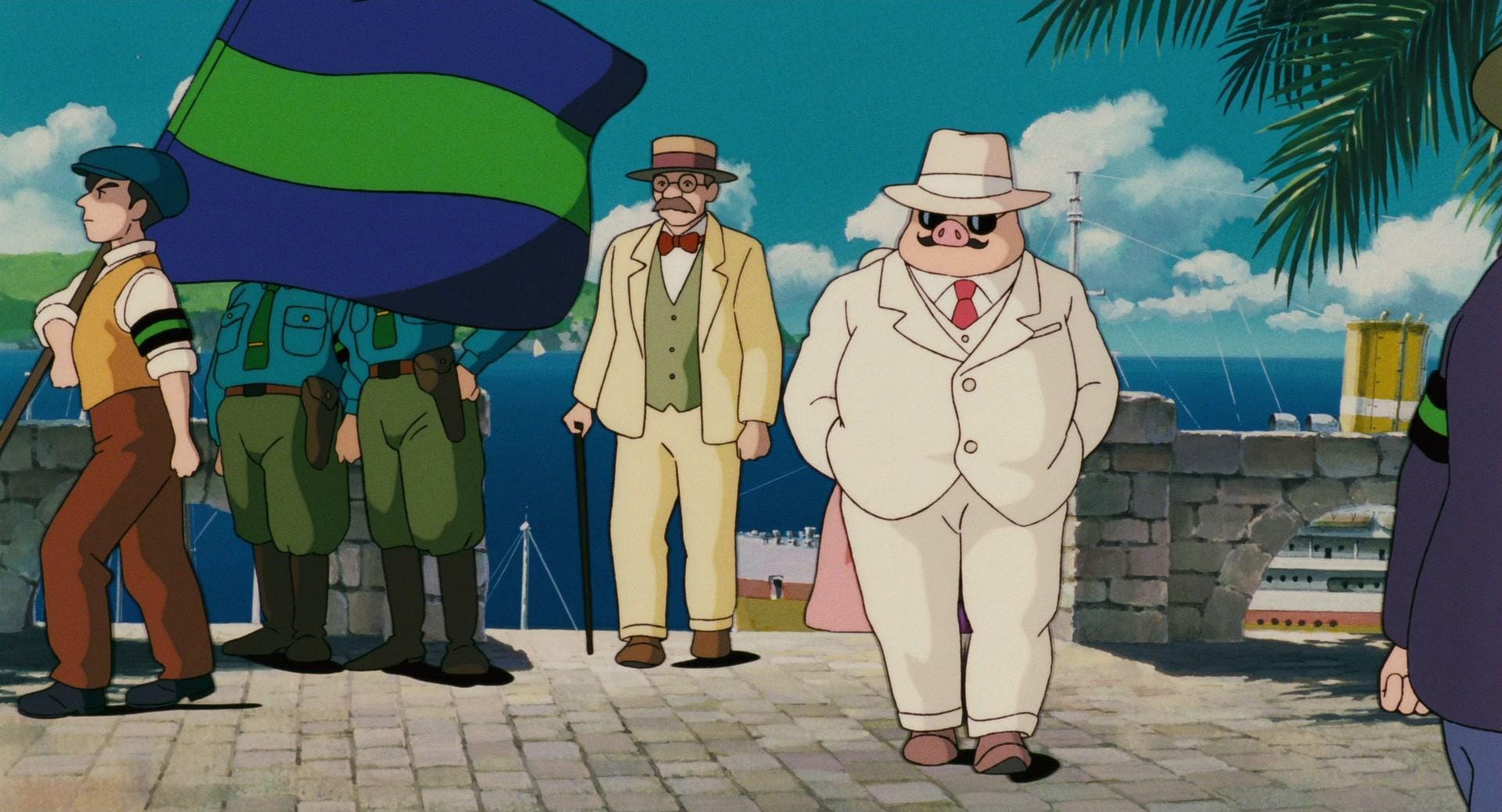 11. Porco Rosso
The scenery of the Adriatic is beautiful, but the action is surprisingly clumsy and uncompelling, the secondary characters are sort of undercooked and unlikeable, and the Japan Airlines dub is HORRENDOUS. Porco e Bella is one of Joe’s best and most underrated themes.
Marco, a veteran flying ace who is inexplicably also a pig (we hear brief mention of a curse, but know not its provenance) takes up bounties in his red flying boat (a seaplane with a strange engine), fighting sky pirates who prey on the pleasure craft in the Adriatic Sea. Mechanical issues and a chance shoot down by an arrogant American ace in a new-fangled floatplane drive Marco ashore to the illiberal interbellum Italy, where he secretly reconstructs his craft. The mechanic’s granddaughter Fio takes a shine to Marco and they work together to get revenge on the American who shot him down. Hijinks (precisely two of them) ensue.
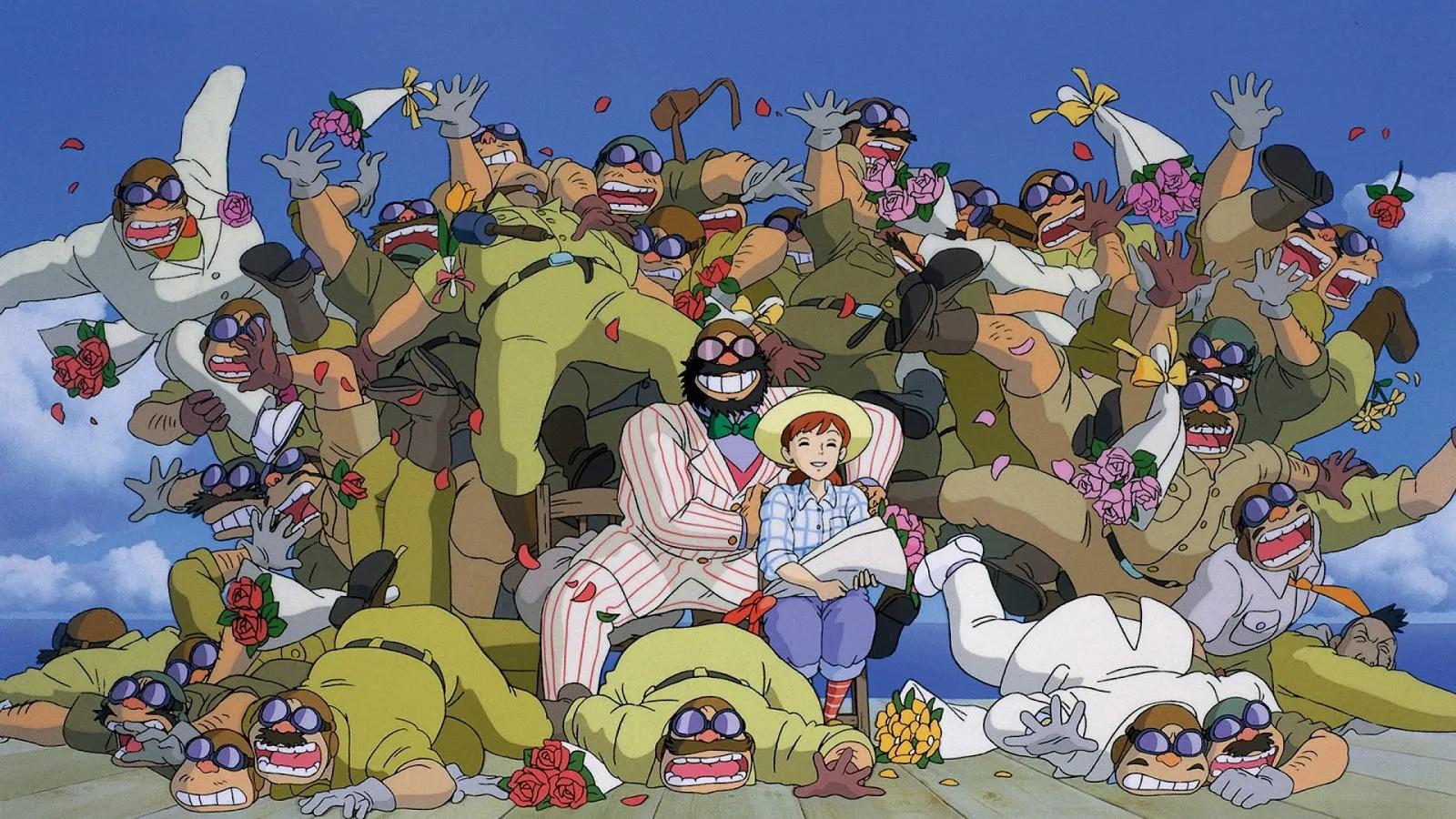
Porco Rosso reminded me a lot of The Sun Also Rises by Ernest Hemingway, which happens to also be about a morose WWI vet bumming around Europe sporting a weird one-sided relationship with a highly desirable socialite that is hampered by a physical deformity. This of course has much more of Ghibli’s signature anti-modernist heart of gold than Hemingway, with Marco pitted against a crew of lovable scoundrels (though not quite as lovable as Castle in the Sky’s pirates!) to save a precocious young girl who has latched on to him.
At the end of the day it feels like it cribs from other Miyazaki films and is runner-up to all of them. The setting and especially the secondary antagonists are sub-optimally copy-pasted from Castle in the Sky. The backdrop of the rising militarization and societal alienation is more deftly integrated in Howl’s Moving Castle. The hyper competent and suave protagonist is better realized in Lupin in Castle of Cagliostro. There’s also of course The Wind Rises, but we’ll get to that later.
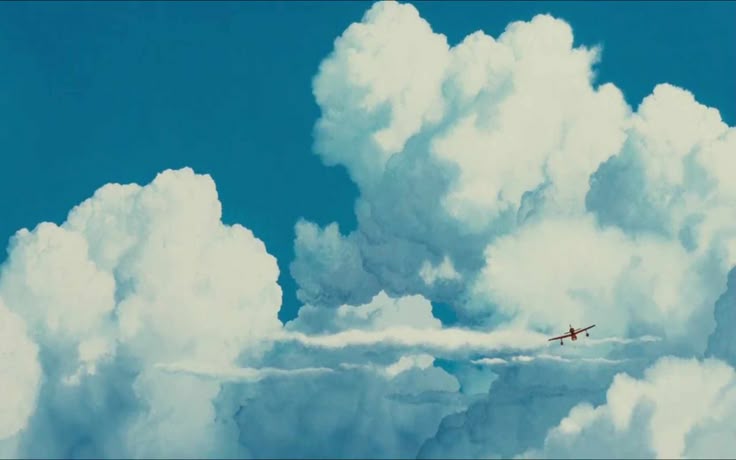
There is one standout scene that manages to save this film from being completely obsoleted by its betters: the story that Marco tells Fio. He’s the last survivor of a massive air engagement near the end of the war. He blacks out and has a surreal vision of his compatriots ascending above the cloud tops in their planes to join a great procession of all the airmen killed in combat, headed to… pilot heaven? It’s genuinely moving, it helps Marco’s character finally snap into place. He’s standoffish because he has lost so many loved ones, and he fears loving anyone else lest he lose them too. He has survivors guilt preventing him from enjoying his infamy and renown.
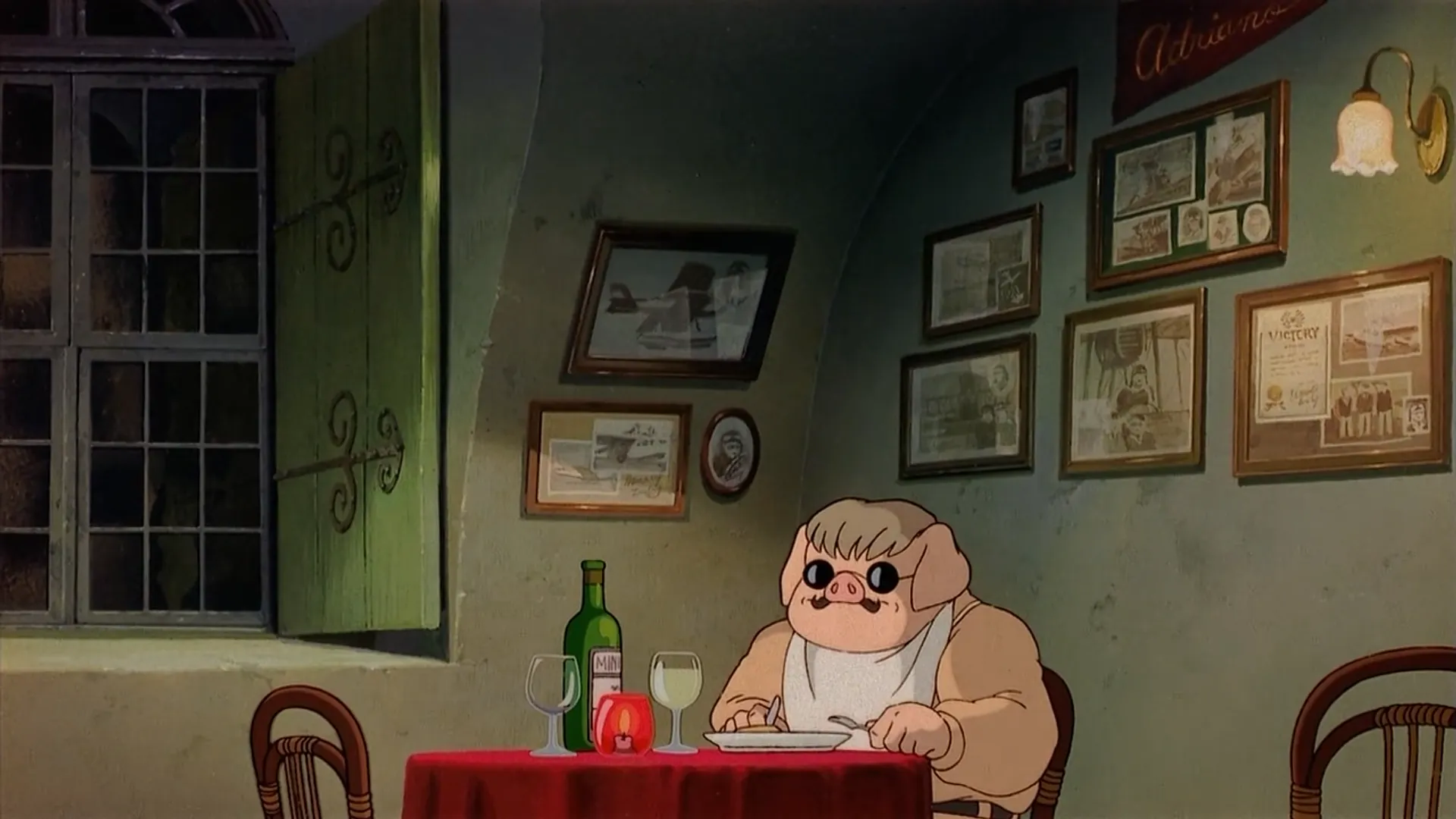
Stack on top of all that his nation’s freefall into fascism leaving him unwelcome in his own home and the crass professionalization and politicization of his vocation. There are three separate instances of characters—Ferrarin, the Milanese gunsmith, and Marco himself—saying something to the effect of “the age of the maverick pilot is over, now cometh the age of the air force”. It’s a dour and unique theme, but exploration of that gets swamped in runtime by the antithetical shrill optimism of Fio. And there’s never a payoff to this dialectic! Marco never visibly lets himself love again, he just ditches everyone once more and flys off into the sunset.4 I know Ghibli goes straight to storyboarding without screenplays, but that’s especially obvious here. It could’ve used several more drafts to hone the uneven themes.
So yeah, that kernel of novel maturity plus the beautiful scenery, the sumptuously animated crowd shots and fantastical mechanical wonders of the flying boats, the jewel blue of the sea and sky, the wonderful nostalgic music from Joe Hisaishi, all recommend it. But don’t expect to come away as narratively or aesthetically satisfied as you would be from most other Ghibli joints. For what it’s worth, Miyazaki says he regrets having made it, that it was indulgent and hyperspecifically catered to his own tastes. Maybe there’s a lesson there for all creators.
 10. The Boy and the Heron
It actually seemed like he was done for real this time. The Wind Rises finally released, and then silence for many years. But like he always does, he came crawling back to make another one. The marketing was mysterious and understated, the title was confusing (it’s How Do You Live? in Japan after a novel that features in the film, but The Boy and the Heron in English), but none of that mattered because Miyazaki’s acclaim and reputation had only reached a fever pitch during his hiatus. There was no chance this wouldn’t be one of his biggest premieres ever, and would you look at that it won him his second Academy Award. It was sort of like Kendrick going quiet for a couple years before suddenly beefing with Drake and coming out with the fairly safe GNX (it was produced by Jack Antonoff for goodness sake) and getting inundated with awards. Absence makes the heart grow fonder. If Spirited Away is Miyazaki’s Good Kid M.A.A.D. City, this is his GNX.
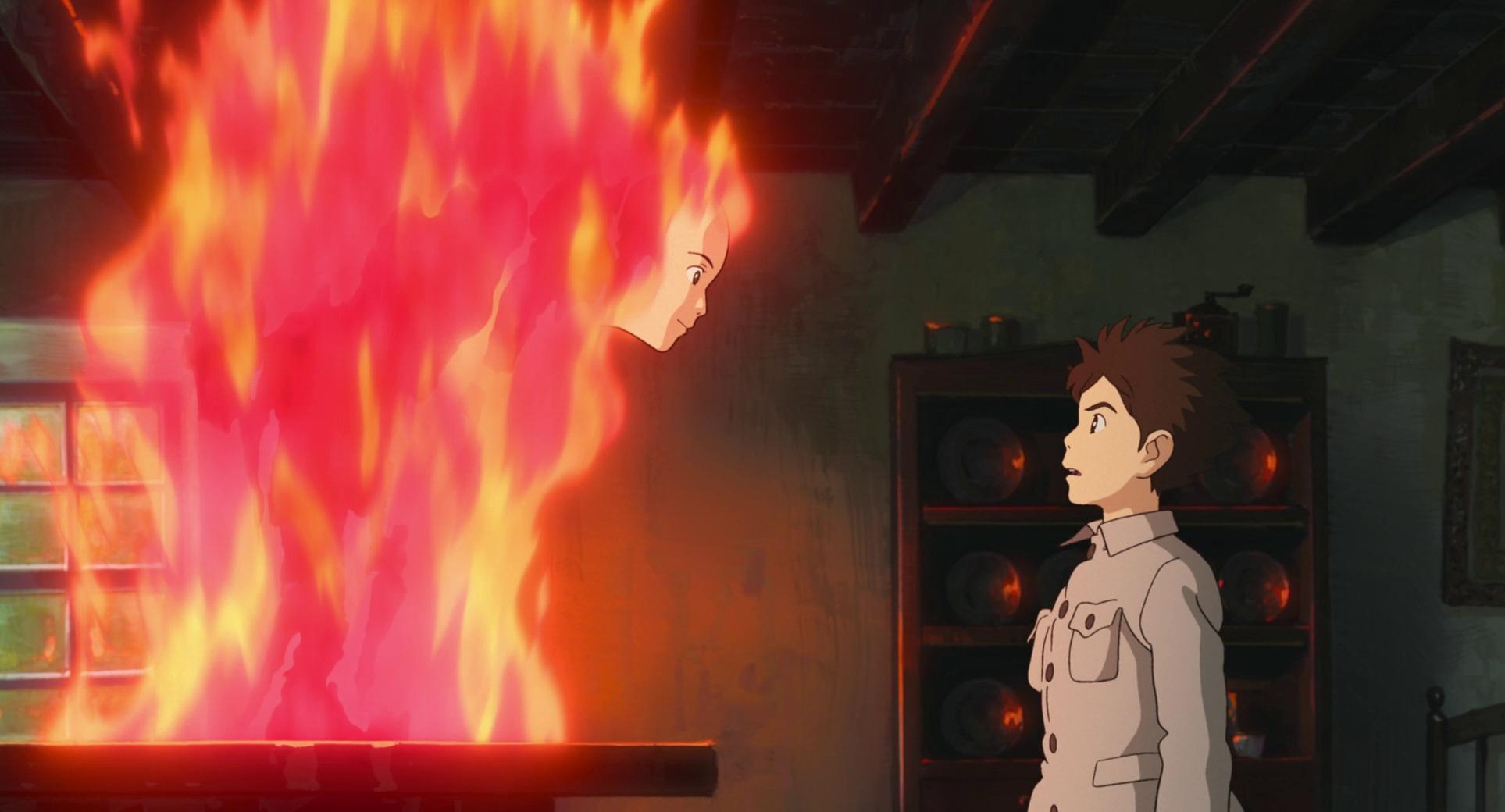
After his mother is killed in a hospital fire, Mahito’s father marries her sister and they travel to stay with her in their family’s ancient estate. Mahito refuses to accept his aunt-turned-stepmother as his new mother, and as their relationship deteriorates she disappears into the woods. Mahito suspects that a freaky talking heron that has been taunting him about his deceased mother is behind her disappearance, so he pursues it into a crumbling tower on the estate, where he discovers that an entire parallel world of magic awaits.
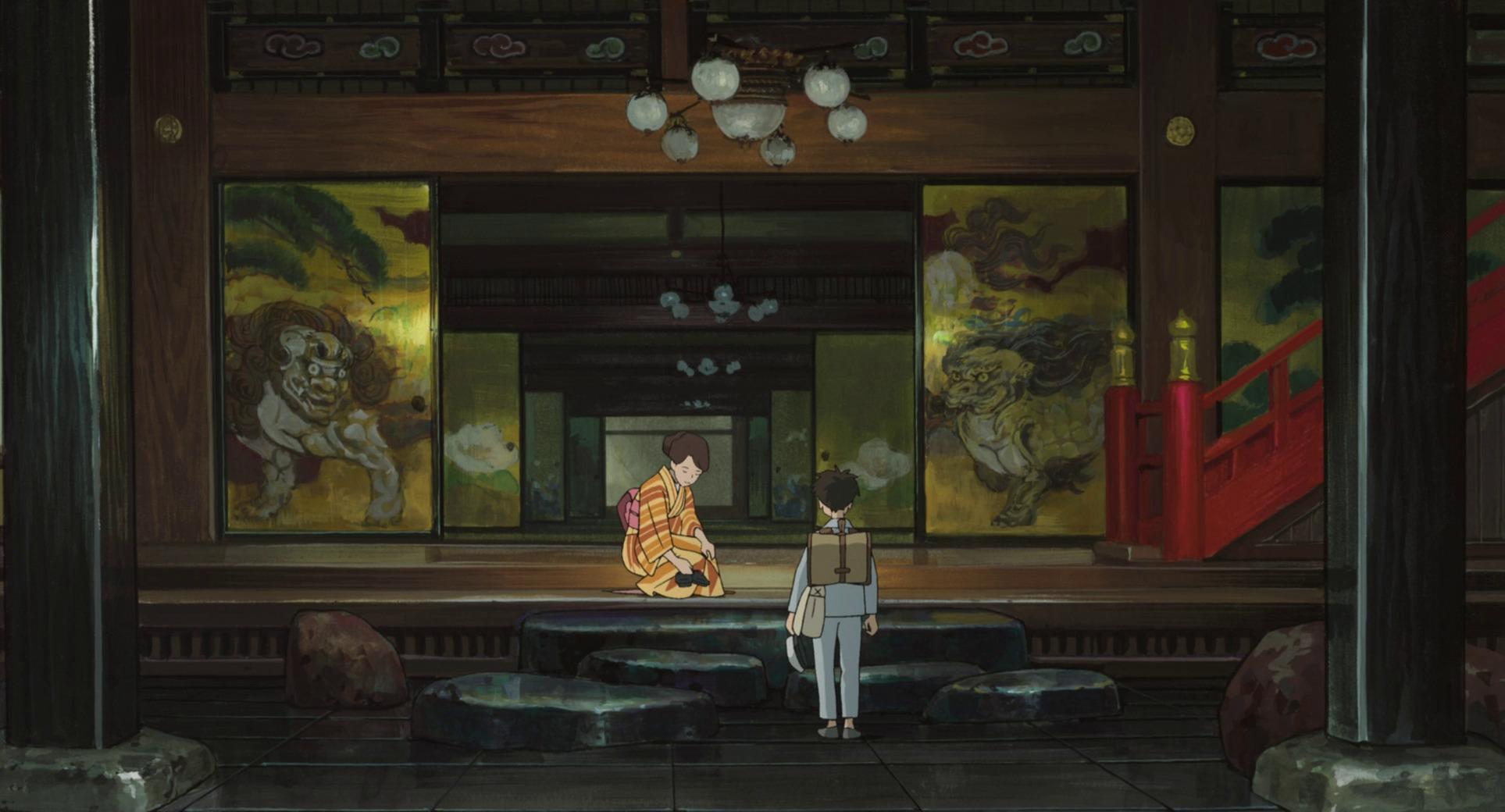
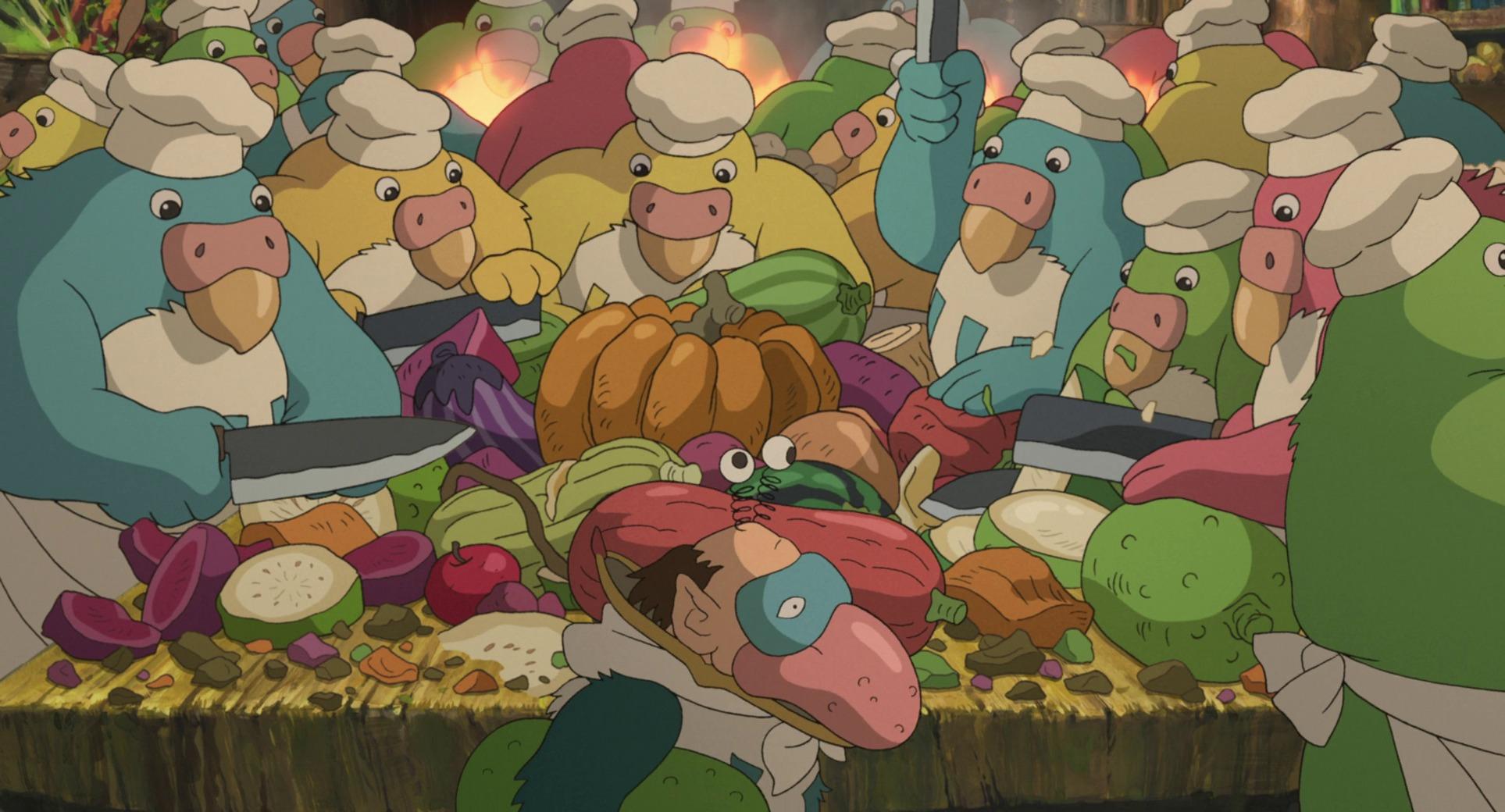
My most common thought while watching this was: “uh… what?” Spirited Away manages to be weird and surprising with its parade of wacky spirits, but the stakes and the direction of the plot are never in question. Chihiro needs to remember her name and earn her parents’ freedom, and we feel her fear and determination. Mahito is closed off and fairly flat. He misses his mom—don’t we all—and he doesn’t like her replacement, and he doesn’t like the heron. That’s about all I can say about his character. He doesn’t really emote, somehow befriending the various individuals he encounters along his journey without saying more than a couple sentences to each of them. The first half is ponderous—sometimes excruciatingly so—as Mahito mopes around his estate. It is only a whole hour in that we finally enter our parallel universe. And then things just keep happening. Some new encounter shows up over the horizon and then recedes into the distance. There are very few solid throughlines here, characters and settings enter stage right and exit stage left. The ostensible antagonists—the parakeets—don’t make an appearance until three quarters of the way through. It could be this is intentional, a juxtaposition between a claustrophobic reality and an agoraphobic fantasy, one too small and one too unfathomably huge. But it’s just not interesting to watch. No time is spent explaining why anything matters or how anything works.
There are certainly some interesting thematic preoccupations at play here. It is never stated out loud, but the world that Mahito enters in the tower is some sort of world of the dead. The first thing he lays eyes upon is a graveyard. Everybody and everything is starving, trying to eat each other to stay around just a little longer. He kills a giant fish and feeds it to tiny blob spirits. He buries a dying pelican. His compatriots are impossible manifestations of the deceased and the soon-deceased (also known as “the elderly”). Amid all this death and devouring, the most ominous place of all is the birthing room, a place so taboo he is not to enter. Other oddly specific recurrences: birds (parakeets, pelicans, herons), and getting dressed and undressed. It sort of feels like the studio discovered they had finally cracked how to animate birds (and also someone putting on pants) so they just cooked up the maximum number of sequences they could cram in one story.
There are moments where some localized stakes appear and it starts feeling like an actual film. The two scenes where Mahito and the Heron are escaping/outwitting the parakeets, the initial entrance into the tower, preparing the fish for the Warawara, these are Ghibli doing what it does best. And there’s a certain meaty autobiographical bent to story, one that recalls Miyazaki’s own experience during the war as the son of a plane part factory owner (the exact role that Mahito’s father occupies), feeling alienated from a country that was starving around him while he lived in comfort, a mother figure in peril (his mother had spinal tuberculosis).
Even the animation is sort of uneven, with high highs and low lows. The enormous parakeet colony, the interior of the tower, the heron and pelicans’ lifelike movements, the introduction to the countryside are top-notch Ghibli. But the character animation on the old ladies, and the muddy painting choices for the backgrounds in the estate sequences, and the underwhelming setting for the final confrontation, all leave something to be desired from the same team that did The Wind Rises and Spirited Away. The soundtrack is overly minimalist, makes me wish to hear the main theme more, just like Totoro.
I am baffled by the overly warm reception this film received. I think we were starved for anything Miyazaki for a decade and had a sort of embarrassingly overeager reaction to his return. On the other hand, it may be me who is being overly critical because I’m comparing it to the high heights that Ghibli has reached. I’m perfectly open to the idea that every Miyazaki film ever released deserved the animation Oscar for the year of their release. That’s how positive my opinion is of this creator, even in his bottom quartile of works. What is confusing to me is why that isn’t the case for his peaks—like his previous film, The Wind Rises—but it is the case for this one. It makes me very suspicious that there has been a sort of elite consensus around Miyazaki’s greatness that has formed in our decade without him, and this is essentially the exact thing that played out with Kendrick Lamar’s GNX and Not Like Us, which—in my humble opinion—quite obviously did not deserve the Best Rap Album Grammy + sweeping the individual song category more than, idk, Good Kid, M.A.A.D City?? Does The Boy and the Heron really deserve the Academy Award that was denied to Ponyo and The Wind Rises? Something is fishy here, it rattles my faith in critics as a trustworthy class. I don’t think time will be kind to this film.
 9. Kiki's Delivery Service
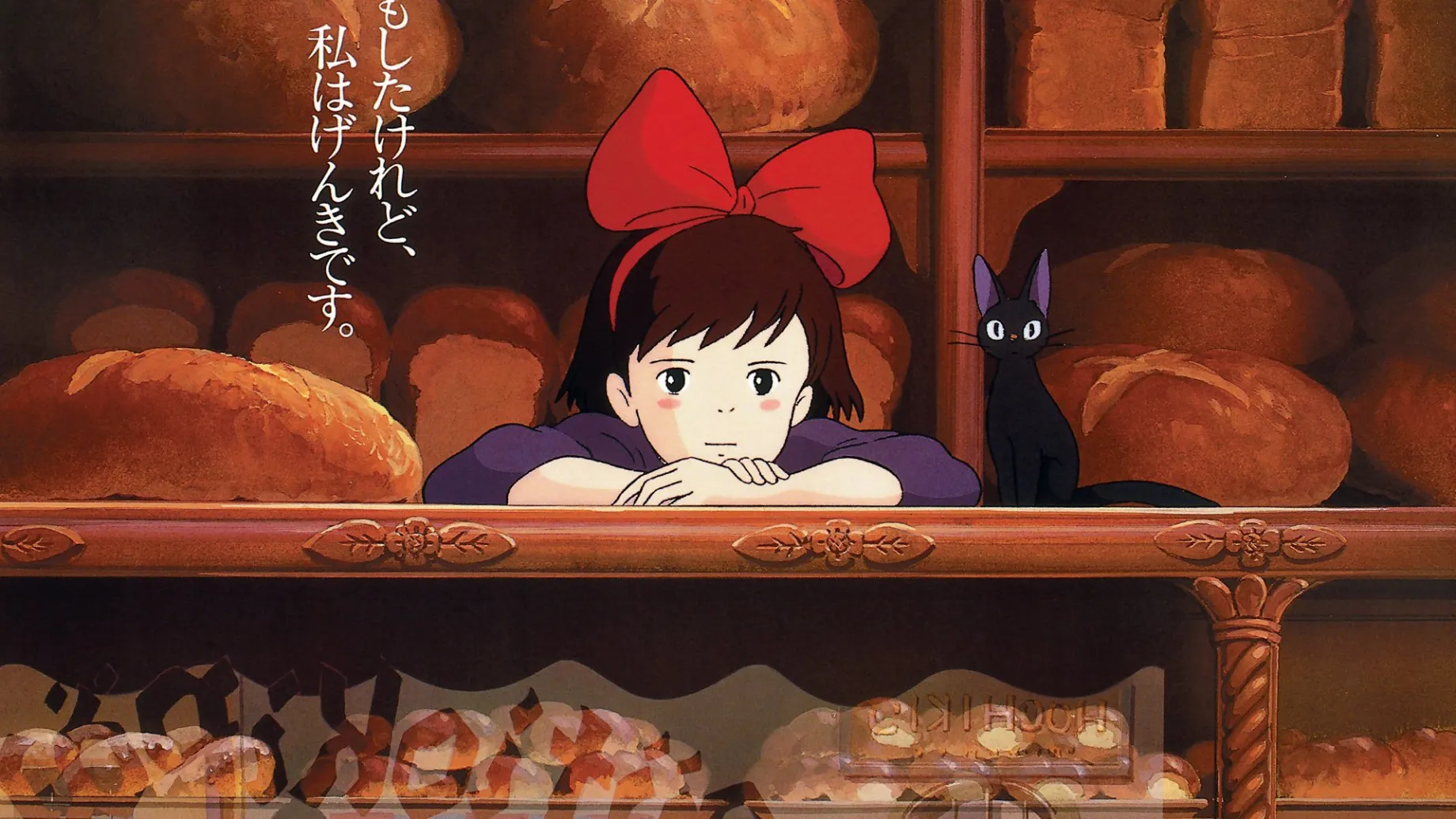
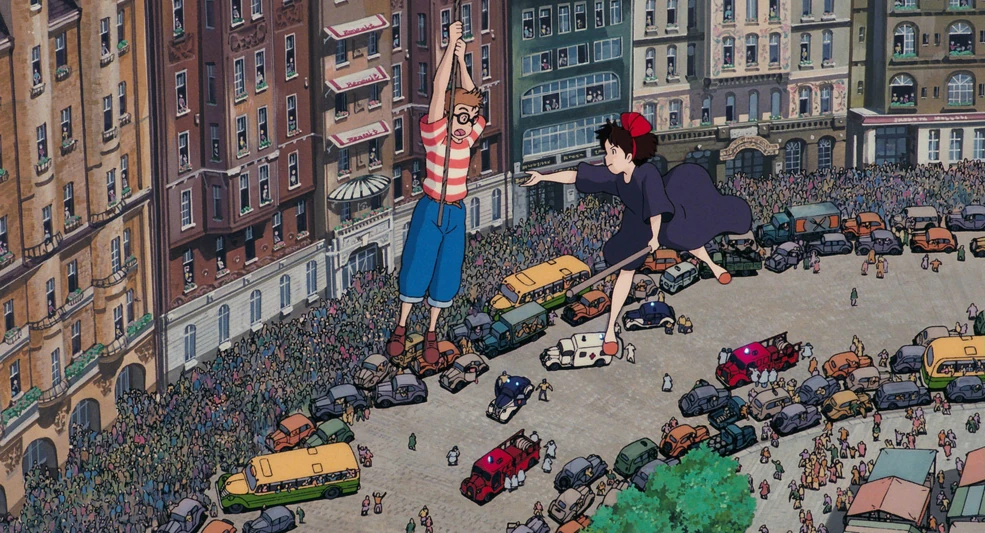
Coming hot on the heels of Ghibli’s comfycore Totoro (barely over a year between them! Could you imagine the reaction to two release years in a row during Late Miyazaki?) we have another attempt at a wholesome magical story with a young female character, and this one connects much better. Rather than the sleepy countryside, this one situates us in a bustling old-fashioned European city by the sea called Koriko. With perfectly clean cobblestone streets and orderly crowds, it makes one a little wistful when beholding the current state of the Western city. That’s the power of the Ghibli lens! Koriko is incredibly detailed and immersive and the real star of the film, a feat that would only be surpassed in From Up On Poppy Hill directed by his son Goro (but written by Hayao, you can tell because it too has a jarring ending). Kiki is the only properly “urban” Miyazaki film (the storybook cities of Howl and the fleeting glimpses of Tokyo and Milan in The Wind Rises and Porco Rosso notwithstanding). Of course our story still has to escape the city to the forest multiple times, it wouldn’t be a proper Ghibli film without some stunning nature would it?
Kiki is a 13 year old witch in training who must go find a new town to settle in and become their resident witch. She lacks any witch skills besides flying her broom (and she’s not amazing at that either) but she’s incredibly independent and intense. She establishes a delivery service in Koriko and goes above and beyond to complete her delivery jobs, all the while wrestling with feelings of inadequacy as her dreams and plans collide with reality. From her repeated acts of compassion and integrity she makes a series of friends who help her out of the doldrums to unleash the hero lurking inside her.
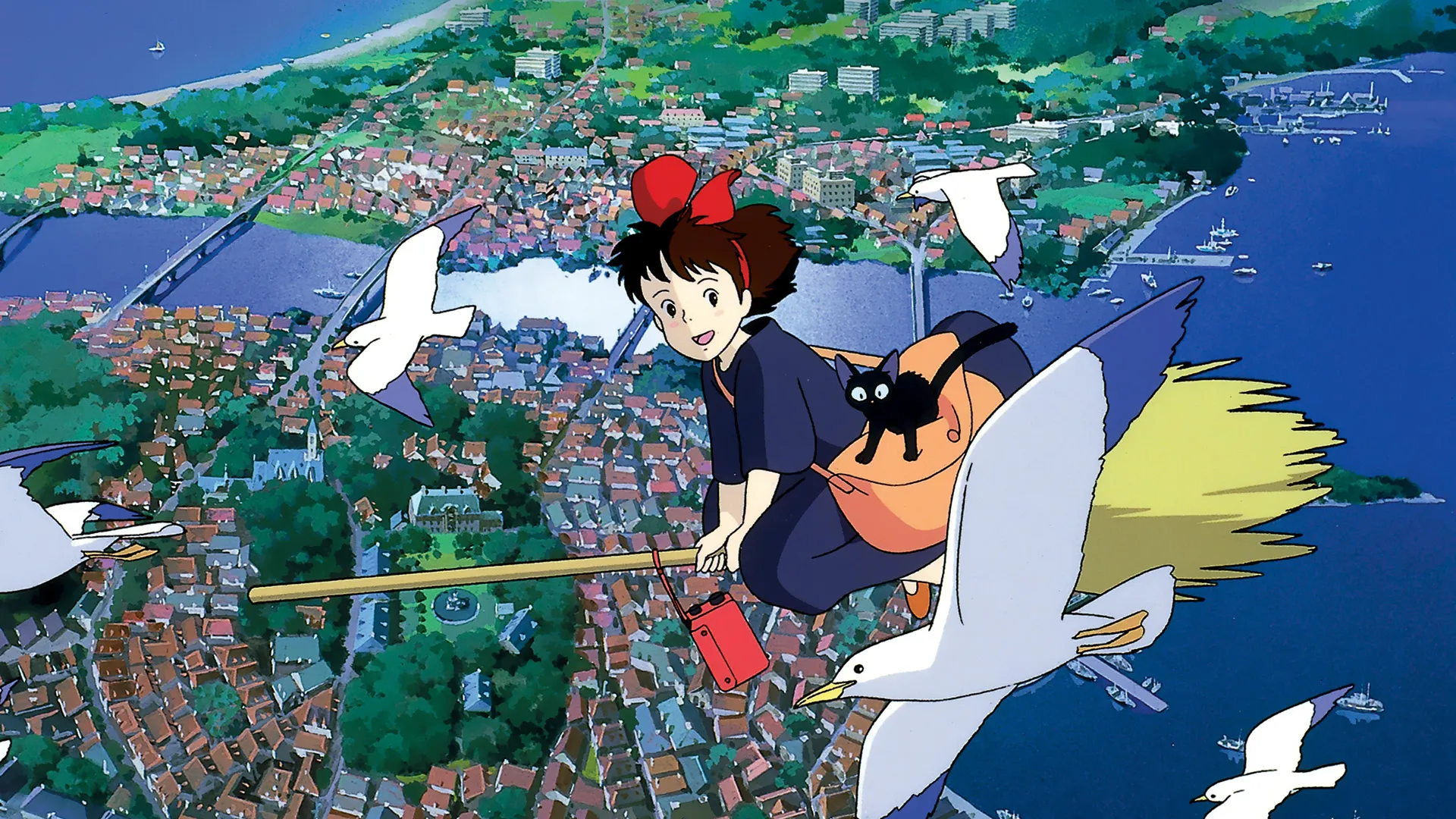
Kiki is a very kind film. With the exception of other girls her age, who are all rude and shallow and are sort of the closest we get to an antagonist, every character is incredibly patient and altruistic. It is also a noticeably female cast, with the only named male characters being her father, her cat Jiji, a little boy who receives a package, and the not-so-secret-admirer-turned-damsel-in-distress Tombo. I suppose there’s also Osono’s husband but he’s basically nonverbal. Just as Totoro before demonstrated a hyperreal understanding of pre-adolescent girlhood, Kiki is a truthful exploration of young womanhood: the constant comparative status games, feelings of not measuring up, people-pleasing to the detriment of your own health, treating uninvited attention from a boy with suspicion, wanting a little place of your own. I wish I knew the women in Miyazaki’s life a little better, there’s no way he figured all of this out all by himself.
There are essentially three phases of conflict. First, Kiki needs to find somewhere in the city to lay her head. As someone who has spent a lot of long Saturdays meandering around random towns while I wait for my wife to finish up a photography job, this was painfully real: totally surrounded by humans yet profoundly alone. A city is a wonderful place of bounty and safety as long as you have money and somewhere to go for the night, otherwise it turns to a concrete desert more hostile than any wilderness. Once she is situated at the bakery, Kiki goes on a lot of episodic deliveries, contending with sudden gusts of wind and pecking ravens and heavy boxes and inaccurate clocks. At the end of her travails she quite suddenly slips into a deep depression without any clear cause. She loses her ability to fly and to understand her talking cat. Her final obstacle is herself—learning to let go of her anxieties and stop the constant rumination so she can just be the lovable and loving person she is. She is only able to break out of this funk when she is forced to spring into action to save her friend, a perfect representation of the quality of her character.
The pacing and plotting of the third act is a mess. Her spiral into losing her powers starts out of nowhere, with no inciting incident—I guess she saw that Tombo was friends with a girl she doesn’t like? What’s the big deal? Then the story ends extremely abruptly at the resolution of the climax, cramming the denouement into some illustrations that roll with the credits. It speaks to a rushed production. In a world where the third act had more room to breathe at the beginning and end, Kiki would probably be way higher on the list.
I love Kiki the witch. She reminds me so much of my wife. Both are young (Asian?) female entrepreneurs with wavy brown hair that will move heaven and earth to make their customers happy. Both are kind people that charm everyone they meet. Both are a bit mercurial and prone to sudden episodes of doubt and fear, crushed by their expectations for themselves, yet both are also able to just as suddenly forget all of that and spring into action to save the day. And both randomly break into side-splitting laughter when beholding the face of their bespectacled blond beau. Kiki is the best. I only wish she was given a more fully realized character arc. And a better soundtrack.
 8. Howl's Moving Castle
Just as he did with Lupin, Miyazaki takes an adaptation and totally makes it his own. Unfortunately it also pivots around one of my least favorite fantasy tropes: innocent but strong-willed girl gets entangled with a powerful, mysterious, and abrasive sexyman. You know, spiritual children of Beauty and the Beast. The central conceit of every romantasy published in the last decade. You’re better than this!
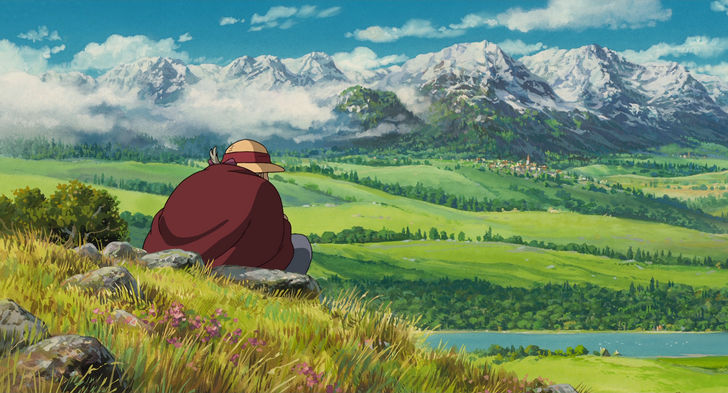
Sophie is a shy hatmaker who gets pulled into a world of feuding wizards after she is cursed to become an old woman. Since she was never really living the young girl lyfe anyway, being an old lady sort of suits her. She flees into the wastes—a strange name for emerald meadows surrounded by majestic mountains and crystal lakes—and happens upon the wizard Howl’s castle, a mechanical behemoth piloted by the imprisoned fire demon Calcifer. Pointless war has erupted between the storybook nations, and Howl is sneaking out nightly to try to frustrate their attacks, slowly losing his humanity. Sophie’s arrival upends his rootless bachelor lifestyle. She brings cleanliness and order to the disgusting castle and fills it with love and companionship, a force she is able to use equally effectively to save Howl from himself.
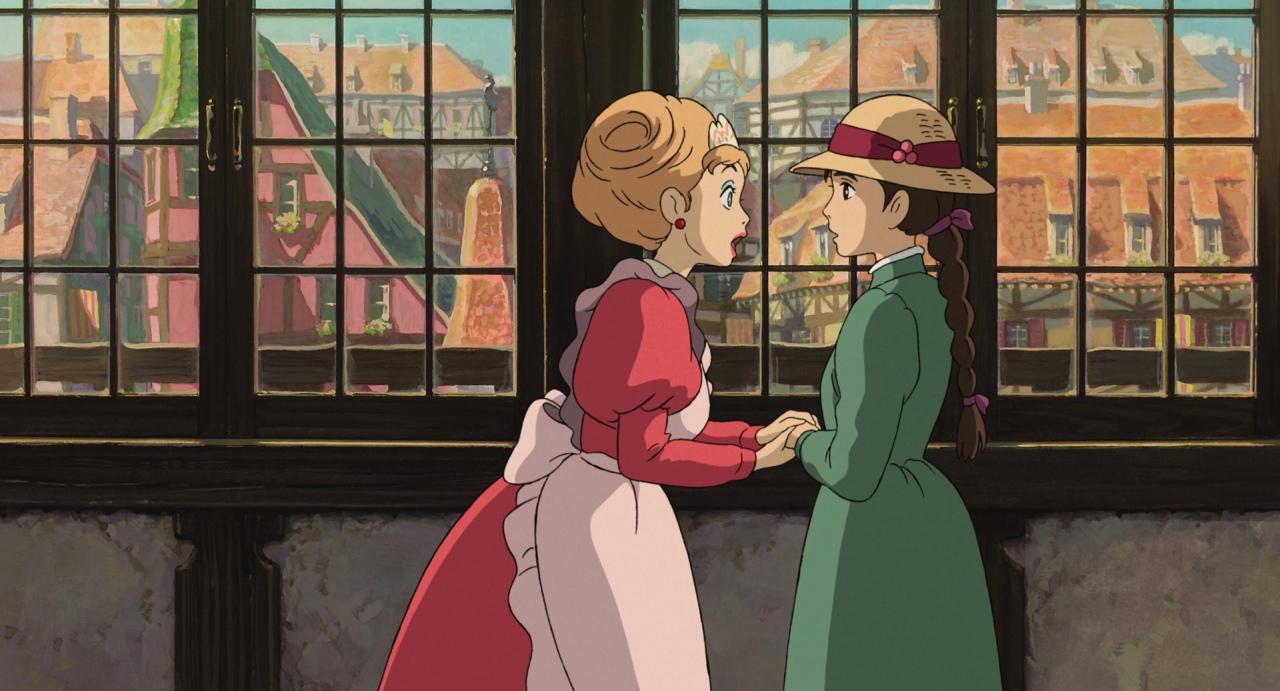
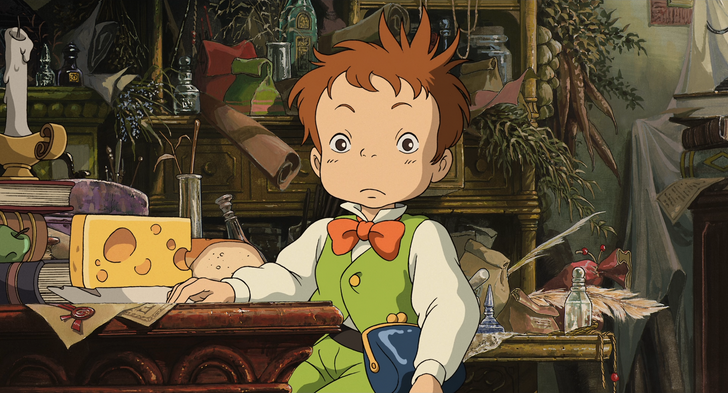
Roger Ebert famously didn’t love this one. It’s one of the less thematically hefty Miyazaki films, on par with Cagliostro. What sets Cagliostro apart is a very unique and lovable cast of characters. Howl’s characters are lovable, sure, but unique? Sophie is just Kiki turned into an old lady, Howl is a slightly less emo Edward Cullen, the Witch of the Wastes is Yubaba, and so on. This is the hazard of adapting a popular novel originally penned for western audiences—you lose some degree of creative freedom, which is a much bigger problem for a studio with such high expectations for novelty. The two characters most transformed from their book counterparts—the fire demon Calcifer who has been softened into a harmless Mike Wazowski (yes he is voiced by Billy Crystal) and the apprentice Markl who has been drastically aged down—are the most interesting. It’s an anti-war film—aren’t they all? This one is supremely on the nose, but the portrayal of the war itself feels a little floaty. It lacks the impact and tragedy we see in Nausicaä or Mononoke, the subtlety and reverence of The Wind Rises and Porco Rosso. And then to top it all off the way the conflict wraps up in the end feels incredibly contrived, which is a shame because the story does a pretty good job of building tension and raising the stakes right up to the climax.
It sounds like I’m pretty bearish on this one, but it also has a lot to love! As I mentioned Calcifer is a hoot, he’s like a way funnier Jiji. The castle is super cool, the soundtrack is perfect, the landscapes are fairly unique compared to Ghibli’s usual fare, and it avoids most of the standard Ghibli pacing and accessibility problems (perhaps due to being an adaptation). The worldbuilding is expertly executed and has never been more immersive. Sophie is a great protagonist in the tradition of Miyazaki’s powerful women and somber men. But it feels a little hollow and safe compared to what came before and after it, which was maybe more forgivable in the Cagliostro era than being sandwiched between bangers like Spirited Away and Ponyo.
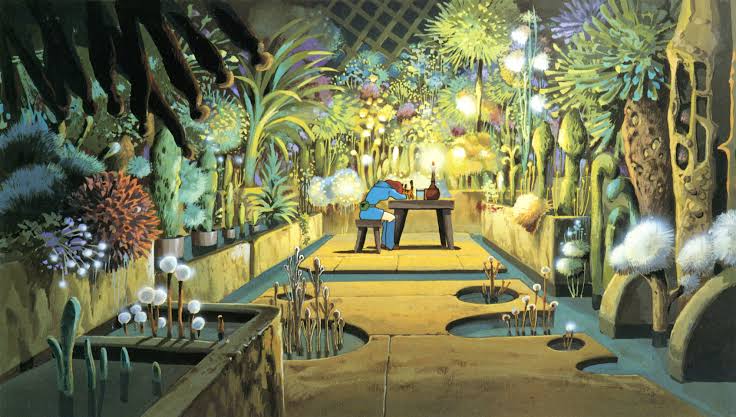 7. Nausicaä of the Valley of the Wind
After the initial success of Miyazaki’s imaginative manga about a post-apocalyptic world where nature has been thrown out of balance by war, he was encouraged by his publisher to make a film adaptation. Miyazaki had been very against the idea of adapting it, but agreed on the condition that he would direct and get to work with his longtime trusted collaborator Isao Takahata, whom he would soon go on to found Studio Ghibli with. But this was before Ghibli, so they needed to recruit a studio. They chose Topcraft, started by Toei refugees that had collaborated with Rankin/Bass to make those weird Lord of the Rings cartoons alongside many forgettable holiday specials. With the special Miyazaki-Takahata sauce they would now be able to create their masterpiece. But it wouldn’t be enough to save Topcraft from bankruptcy. That’s ok, guess who stepped in to buy up the studio and remake it into an acclaimed international juggernaut of animation? Guess!
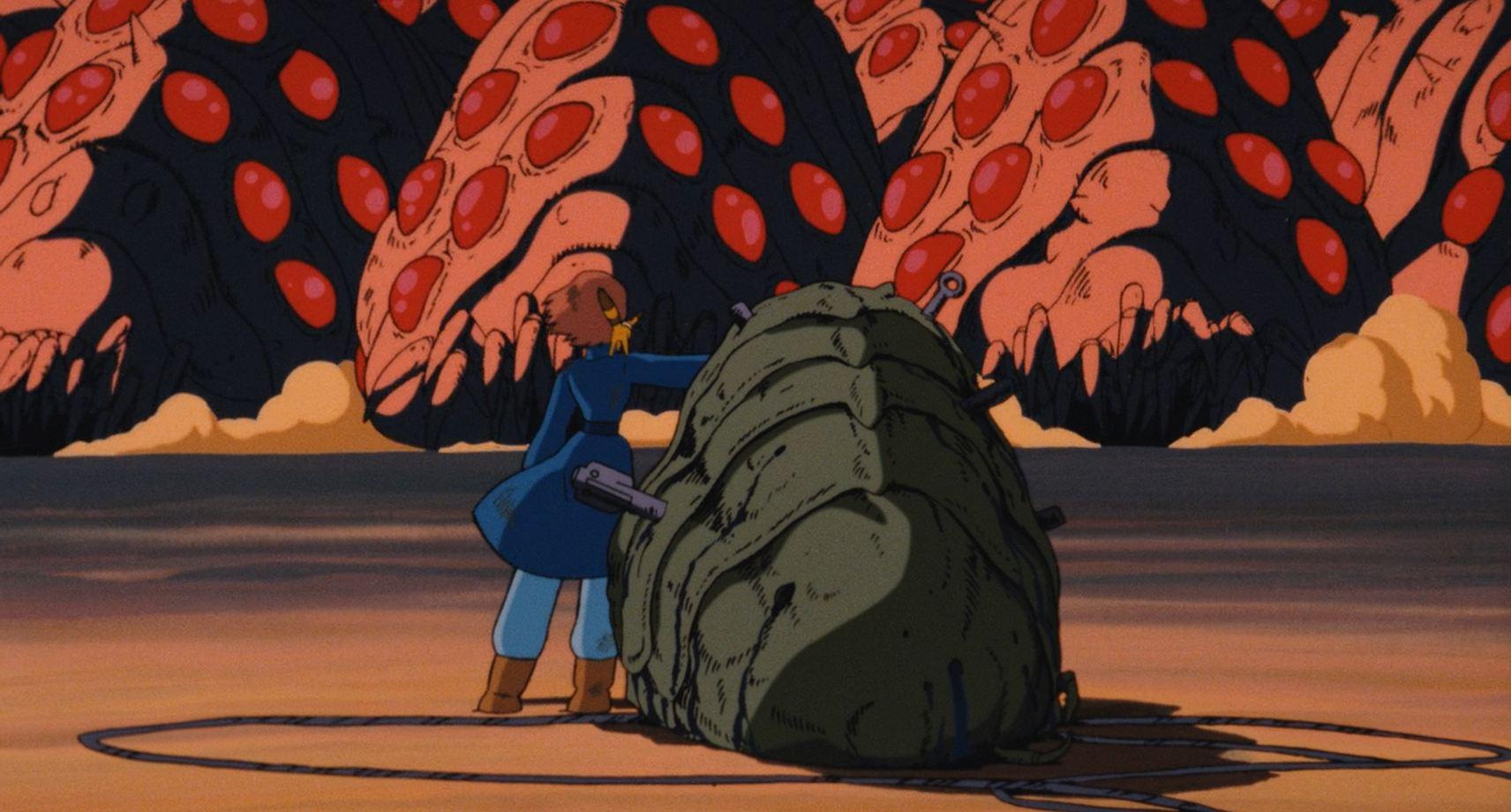
In a world ravaged by war and blanketed by a toxic jungle that emits poisonous spores, our titular princess has nevertheless personally overcome the ancient conflict between humankind and the cruel nature bent on killing them. She feels respect for the enormous mutant arthropods called Ohmu that will swarm and destroy human settlements from time to time. She is beloved by her people of the Valley of the Wind, protected from the spores by an eternal breeze. All of this is jeopardized by a brewing war between the martial empire of Tolmekia and the city state of Pejite. They have unearthed the last of the giant biotechnical warriors that wrought the destruction of centuries past. After a Tolmekian gunship that has stolen the embryonic warrior crashes in the Valley of the Wind, the empire invades and occupies the Valley of the Wind. Nausicaä kills several men in a rage after witnessing them assassinate her father. She is immediately filled with remorse and swears off violence. She advises her people to cooperate with the captors and willingly gives herself up as a hostage. She is accidentally rescued by a Pejite prince, discovers a plan by his military to lure a stampede of Ohmu to the Valley to destroy the Tolmekians, and must race back to save her people from utter destruction.
While the world is wildly inventive, the narrative is fairly well plotted, and the themes are sharp as ever, this is the roughest execution of any Miyazaki film. It’s sort of old and crusty. Something feels a little off about the editing and the pacing and the sound design and even the color choices. But the action is gripping and intense, whether it be the initial Tolmekian invasion or the wild Phantom Menace-style three pronged climax. The real star of the show are the “peoples”, the low-morale Tolmekian soldiers and the fearful women and children of Pejite and the nameless defiant rebels in the Valley of the Wind. Distinct and lively crowds that take on a character of their own. You won’t remember the names of the brave bushy-bearded partisans that commandeer the Tolmekian tank in an uprising, but you will remember their heroism and sacrifice on behalf of the Valley. Even though I will later be making the case that Princess Mononoke is an upgraded version of this tale, I think Nausicaä at least outdoes it in the characterization of the various factions.
This is Joe Hisaishi’s first collab with Miyazaki. The arrangements sometimes veer into strange funkadelic territory, but the melody of the main theme is great, even if the instrumentation is a little bizarre. The manga kept running for more than a decade after this so the whole story feels a little too big, like there are many things left unsaid—because there are!—but it sort of works in the favor of making the film more immersive. The princess herself is a bit of a one note Mary Sue, so San + Ashitaka is another place where Mononoke blows this film out of the water. I still love it for what it is, one of the most aesthetically striking and deeply considered worlds put to screen via animation, and a bombastic introduction to Miyazaki’s no-holds-barred environmentalism.
 6. Ponyo
Just as Mononoke served as a revisitation and strictly upgraded treatment of the themes raised by Nausicaä, so too does Ponyo reprise and greatly surpass Totoro. Both are stories about a pair of young imaginative children cared for by a highly functional single parent separated from their spouse (who is in some physical peril), and the disruptive but ultimately positive entrance of a mysterious and goofy nature spirit (there are even smaller versions of both Totoro and Ponyo!). The only difference is that all of the genders have been swapped, the spirit character has been merged with one of the children, and the plot unfolds in a far more elegant and engaging manner.
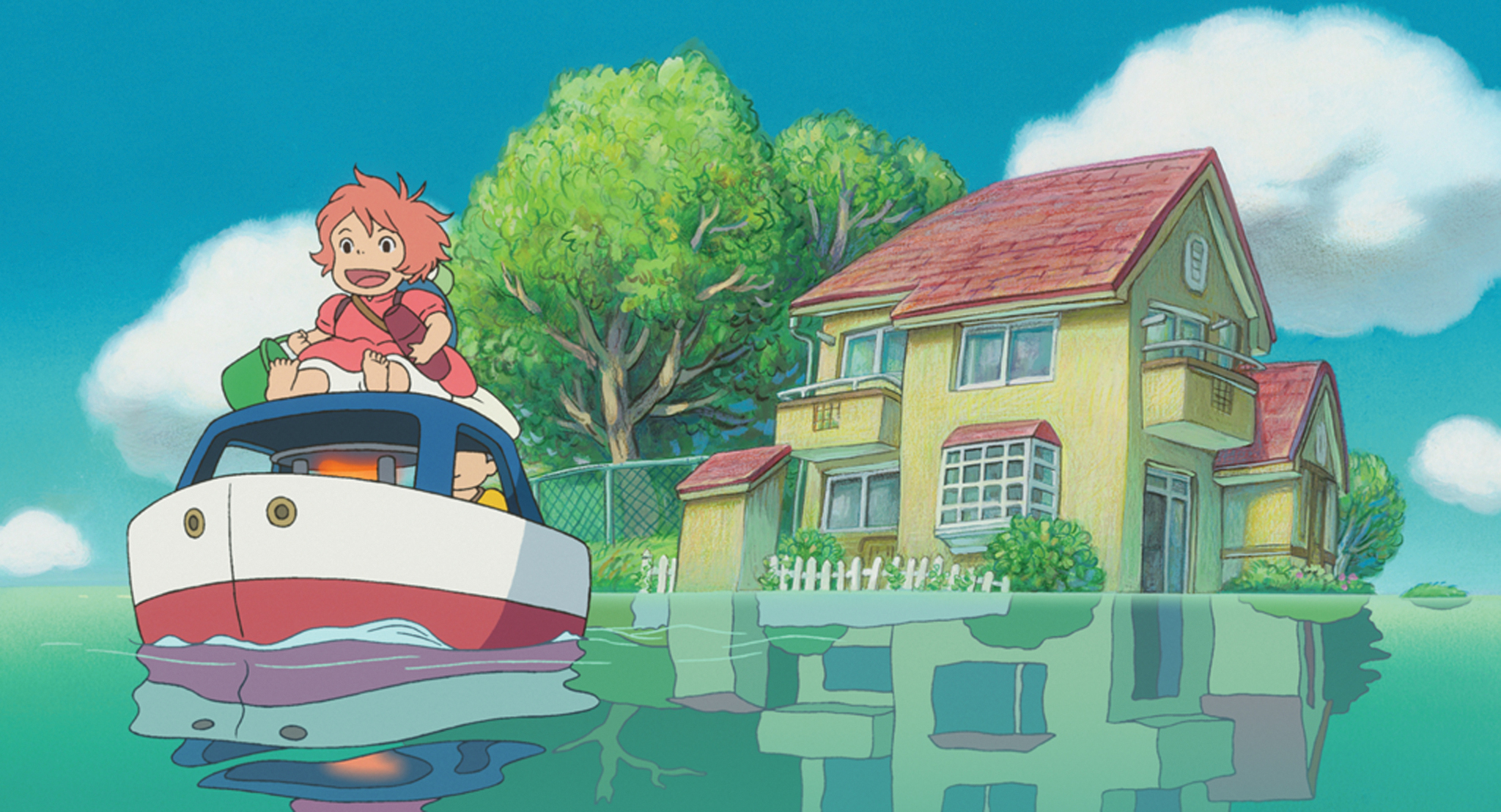
5-year-old Sōsuke stumbles upon a weird goldfish with a human face in the ocean. This is the adventurous and strong-willed Ponyo née Brunhilde, who has just escaped her father: Ocean David Bowie (with a distracting vocal performance by none other than Liam Neeson??). Sōsuke’s fixation and kindness to Ponyo forges an unbreakable bond of friendship and love between the two, and Ponyo determines to transform into a human to be with him, unwittingly upsetting the balance of nature and triggering a massive flood that Sōsuke and Ponyo must brave to find his mother.
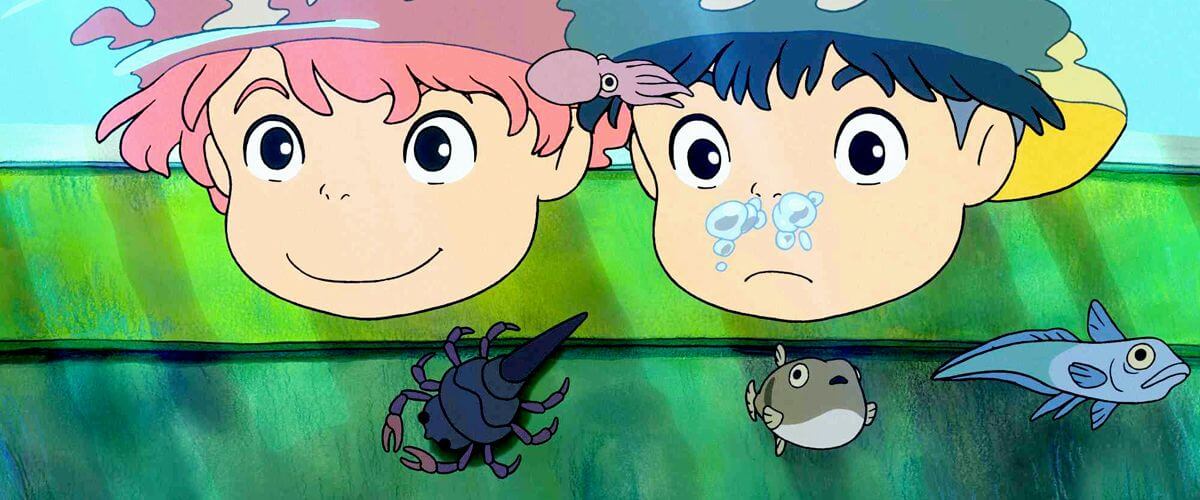
The first thing you will notice is the soundscape. The soundtrack is ostentatious, august, operatic, like you just sat down for a Wagner performance. There is even a certain song that creeps so close to being an outright plagiarism of Ride of the Valkyries. Come to think of it, Ponyo’s real name is Brunhilde… But beyond the music, the foley was apparently directed and mixed by Miyazaki himself, and it’s quite… maximalist. The dialogue weaves with the slosh of water, the clanking of props, the hum of engines, just like the many painterly layers of a Ghibli still. Sometimes it’s a bit overstimulating, but it is the film on this list most deserving of the appellation “Feast for the Senses”. Everything is so sharp and bright and loud and lucid, greatly contrasting Totoro’s sleepy and muted quietude.
We’ve got ourselves another underwhelming Miyazaki Ending, with ominous talk of a “test” for our protagonist that just boils down to like, asking him if he thinks Ponyo is cool? But it’s not quite as jarring as e.g. Kiki because it does not commence and end so abruptly, and not as exhausting as Mononoke or Spirited Away because it doesn’t drag on forever. So while it’s still a little disappointing that there’s no bombastic climax in a story already full of plenty of bombasticism, I think Ponyo is seriously slept on. It has everything: exhilarating peril, unsubtle environmentalism, gorgeous fantastical imagery, great music, lovable characters, lots of laughs. It’s also the only Late Miyazaki that completely eschewed the use of CGI, which gives it a totally unique look among the latter six.
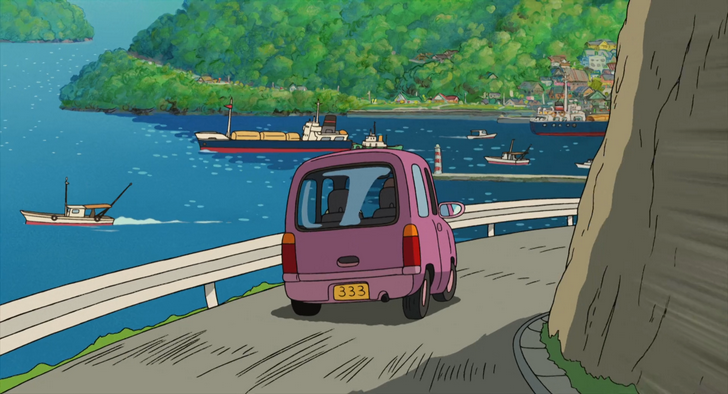
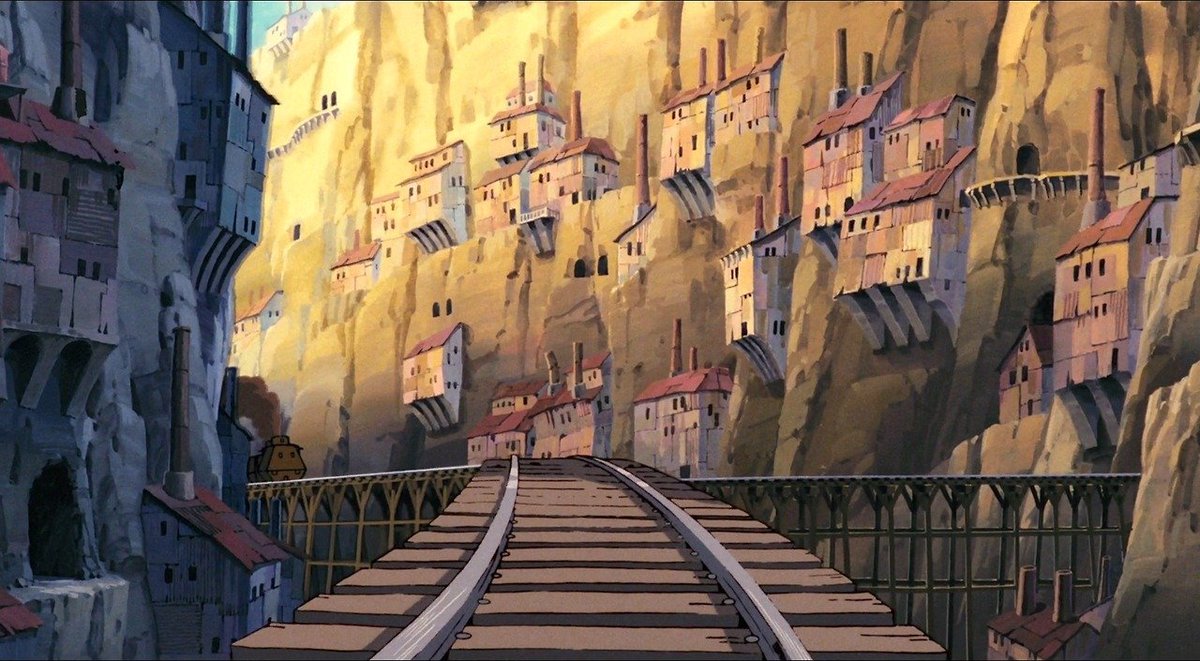 5. Castle in the Sky
I was completely captivated by this film as a child. I had a very narrow conception of what fantasy could be: Medieval European sword & sorcery. Lord of the Rings, Willow, King Arthur, that sort of stuff. I also had a very narrow conception of what science fiction could be: spaceships & lasers. Star Wars and Star Trek. Watching Castle in the Sky was the first time I realized how much bigger the narrative eigenspace was. Not quite fantasy, not quite sci-fi either, but full to the brim with adventure and heart, it was Castle in the Sky—not Spirited Away—that turned me into a Ghibli superfan.
A sky pirate raid on a military dirigible sends an imprisoned princess freefalling down to the surface, but she is rescued by her magical necklace and discovered by miner-boy Pazu. Everyone is after that necklace: both the pirates and her erstwhile captor. The two must evade capture, make unexpected allies, and discover the secret power that she controls: Laputa, the lost floating castle of an ancient technologically advanced civilization. Expect awesome airships, explosions, and lots of swashbuckling action.
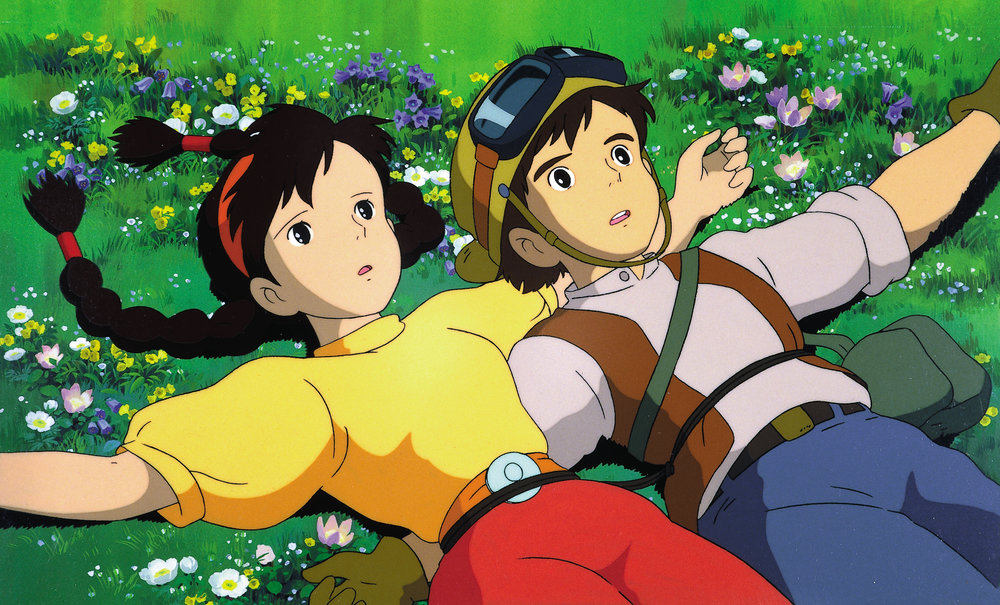
This was Miyazaki’s first feature film with Ghibli, having formed the studio in the wake of Nausicaä’s success. It revisits many of Nausicaä’s soft sci-fi aesthetics with a more steampunk grunge, but rips out much of the world-building complexity and thematic maturity for a more accessible adventure film. And it feels like a very by-the-numbers action adventure flick right up until about the midpoint, when our deuteragonists befriend the sky pirates. In that middle stretch the characteristic Ghibli heart and soul shows itself and offers a counterpoint of optimism that is effectively juxtaposed with the darker and more intense climax.
I find Castle in the Sky to be quite unique among Miyazaki’s works despite its more conventional adventure theming. It masterfully swings between lightheartedness and maturity like Cagliostro or Spirited Away rather than swimming in unending grimdarkness like Nausicaä or Mononoke or saccharine optimism like Ponyo or Kiki. It also seriously sticks the landing, which the vast majority of Miyazaki films do not manage. Sure it’s a little thematically shallow, but the technogenic tragedy of Laputa and the nuclear metaphor have enough meat on the bones to invite deeper analysis. And the chemistry between the two leads is perfect and has never been so successfully executed in any other Ghibli film.
 4. Spirited Away
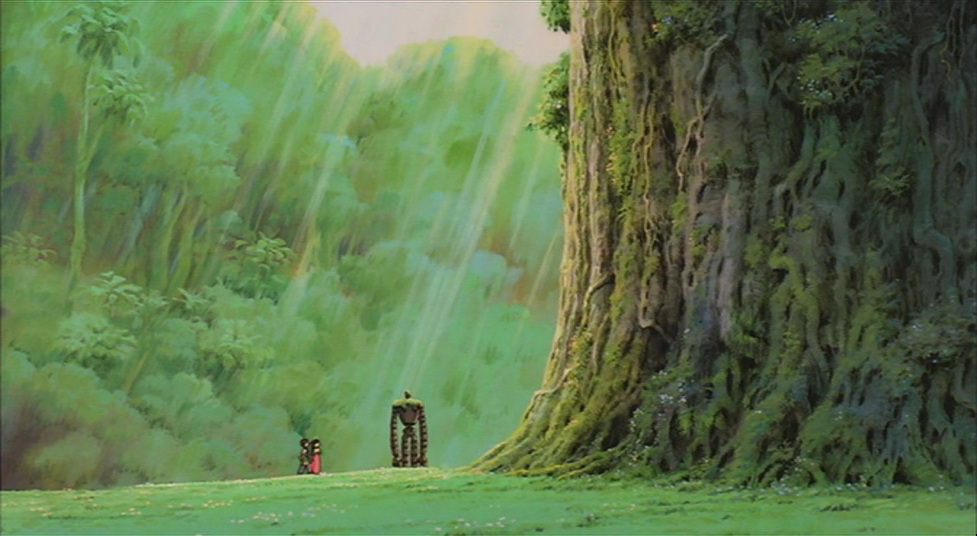
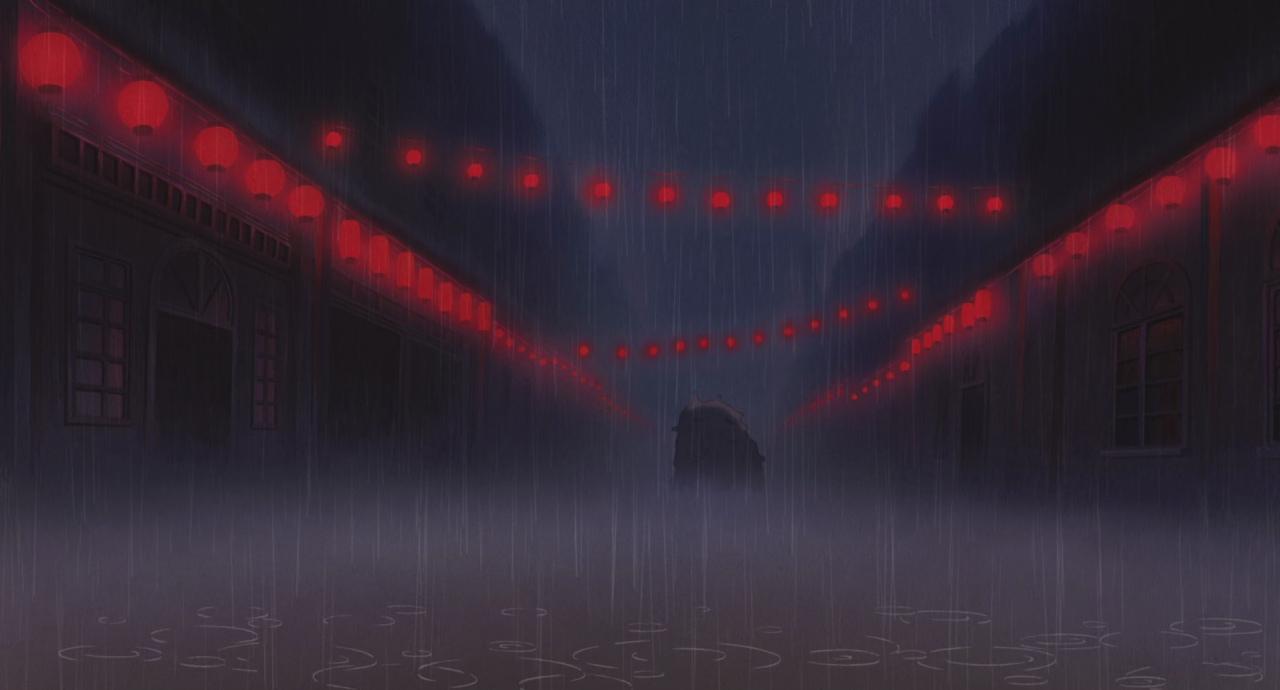
Jostling with Totoro for the honor of being the highest profile Ghibli film, Spirited Away needs no introduction. No Face is the studio’s second most recognizable mascot, the soundtrack is iconic, and it was the first film theatrically distributed by Walt Disney in North America. When you’re watching them chronologically, it can’t help but feel like a synthesis between Totoro’s thesis and Mononoke’s antithesis. Although Mononoke had been a phenomenon, for many westerners this is their first introduction to Miyazaki.
And what a first impression it is! After a short and sharply effective realist establishing sequence plumbing the emotional depths of moving away from the only home you’ve known, we are suddenly plunged into a disorienting world of fantasy and folklore, with a purely Japanese flavor. Ten-year-old Chihiro is separated from her parents and forced to work at a bathhouse for the spirits. She makes some friends and enemies and is swept into a feud between twin sister witches, whom she must reconcile if she is to be reunited with her parents. She starts whiny and helpless, and though every character starts antagonistic to her (except the ever-patient Haku), she wins each over with unshakeable compassion, growing into a strong-willed survivor who is respected and even loved by the craven bathhouse staff.
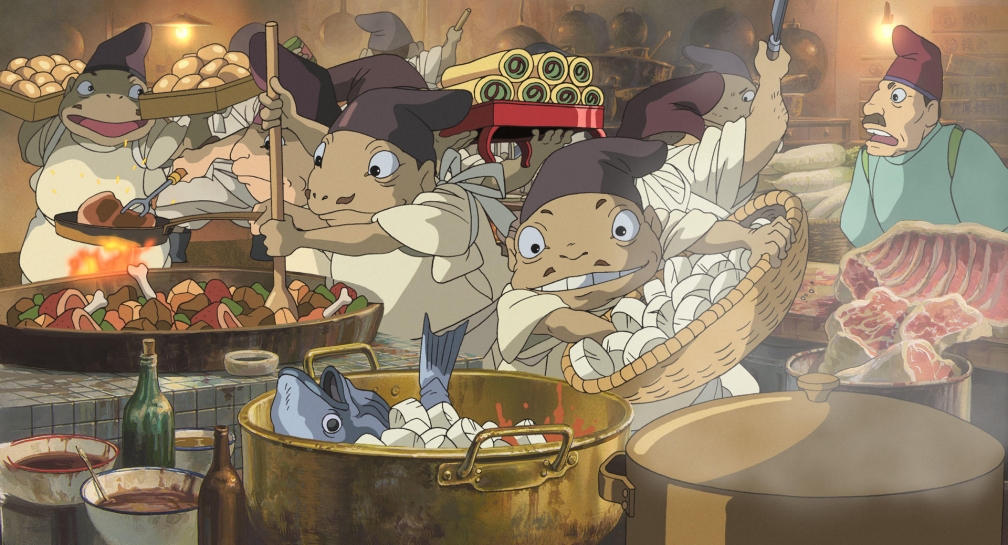
Spirited Away is at once both the most conventional Ghibli film and the most weird (or at least it was until Boy and the Heron came out). The fish-out-of-water narrative frame is perfectly recognizable to anyone who has heard of Alice in Wonderland or any of the many middle-grade fantasy novels that were popular in the aughts (Percy Jackson, Fablehaven, Harry Potter…). Many prior Miyazaki films have a much more disorienting plot structure, eliding the time Spirited Away spends to get introduced to our protagonist in a familiar setting before we’re immersed into a world of dizzying complexity. Here we’re riding along with Chihiro who is just as confused as we are, and it makes the world much more legible. At the same time, the supernatural elements have never been more outré than here. Most fantastical Ghibli worlds are eventually possible to get a handle on, but this one keeps throwing surprises at you. There are no rules, just pure chaotic magic. For anyone who has some experience with the Ghibli modus operandi, it’s a fun romp through the expressive power of animation. But my experience screening this to first time viewers who have not grown up on a diet of eccentric fantasy is that it can be exhausting and somewhat upsetting. I long thought it to be perfect “entry-level” Ghibli fare due to its narrative conventionality and universal acclaim, but we may have to admit it’s just too weird and start neophytes on something gentler like Kiki or Ponyo.
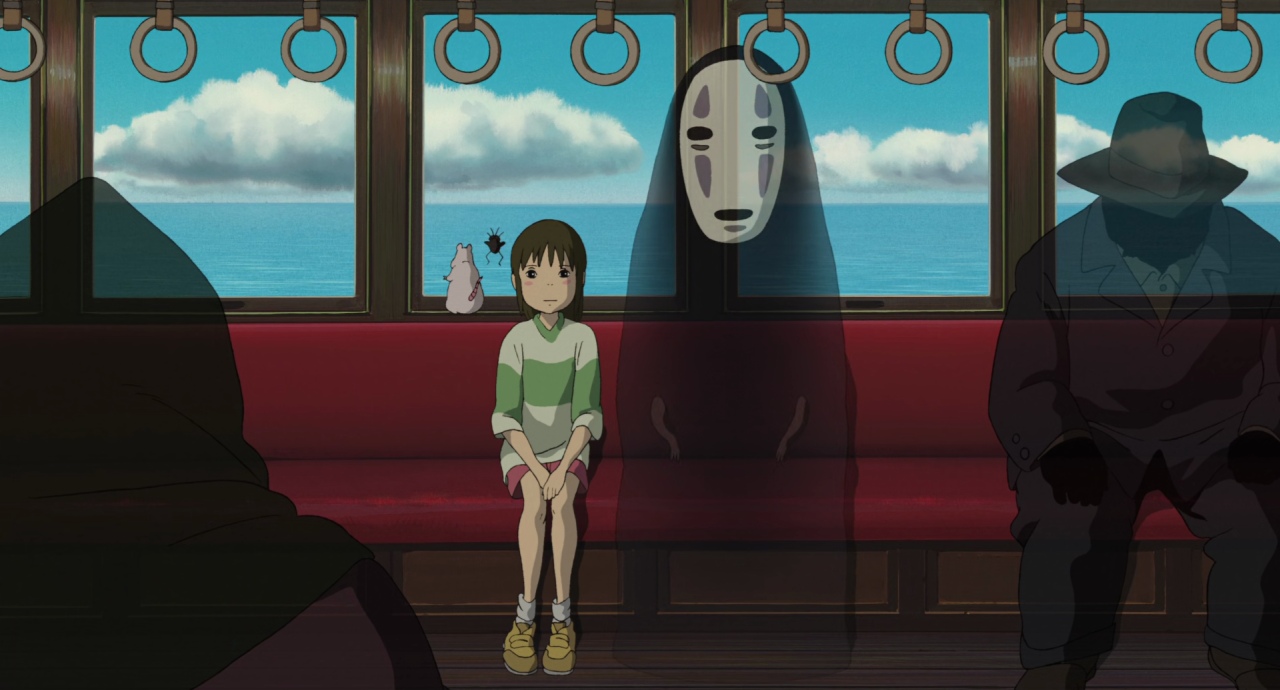
Miyazaki has always struggled with third acts. He is more interested in exploration and experimentation than tight narrative structure, and Spirited Away is one of the worst offenders. The moment Chihiro sets foot on the train, all the plot’s momentum evaporates. We spend the final 30 minutes not in a climactic confrontation but a ponderous journey through Japan’s lost decade represented by the ghosts of commuting salarymen, before arriving at a cozy farmhouse where Chihiro makes one last friend. It’s a sharp turn from the prior assault on the senses, and just doesn’t land. I would be ready to call this film perfect if it weren’t for this boring stretch that has literally put me to sleep before.
We are now firmly in Late Miyazaki: Japanese aesthetics, increasing use of CGI, higher production values, Disney distribution, subtler (but no less trenchant!) political themes. Some think it’s his magnum opus. I would too… if it weren’t for that pesky third act!
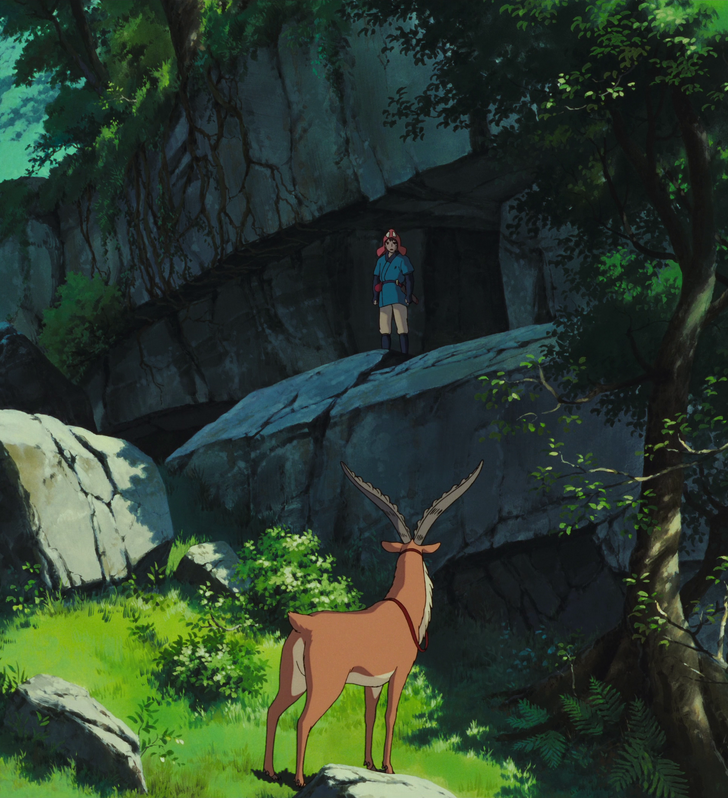 3. Princess Mononoke
The one that changed the course of Ghibli forever. After his hat trick of uplifting stories that was Totoro, Kiki, and Porco Rosso, Miyazaki was ready to tear up the playbook. Instead of playing it safe, he was going to sprint ahead into deeply mature territory. The Nausicaä film had been produced while the manga was still in its infancy. Now that it was finally complete he was going to take another swing at the same radical environmentalist-pacifist themes, trading Near East aesthetics for a recognizably historical Japanese setting, swapping science fiction for fantasy.
Prince Ashitaka is a noble warrior who devotes his life to protecting his people. One unassuming day a bestial god driven mad by an iron ball embedded in its flesh attacks his village. In the course of defending the villagers Ashitaka’s arm is bitten and infected with the same disease of madness and hatred that drove the god there. Ashitaka is exiled and sent west to the God of the Forest so that he may seek a blessing to heal his arm before the infection spreads and kills him. When he reaches the resting place of the Forest God, he discovers that the spirits of the forest—led by wild-child Princess San—are on the verge of all out war with the frontier settlement of Irontown, which happens to be the source of the cannonball that drove the god to Ashitaka’s home. Upon visiting Irontown he finds that the settlement is entirely populated by misfits, escaped prostitutes, and lepers, given a new lease on life by the egalitarian and ambitious Lady Eboshi. Torn between his compassion for the downtrodden people of Irontown, his respect for the forces of nature, his budding romance with the princess, and his quest to be healed, he puts his life on the line to stop the utterly ruinous war that all sides are fatalistically marching toward.
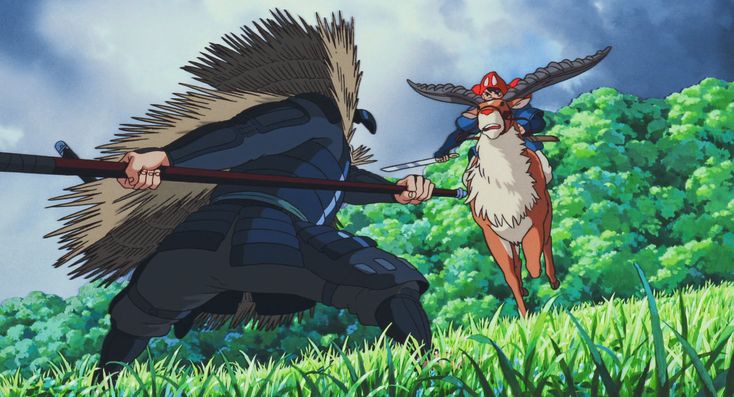
The action in Porco Rosso was sloppy and boring. There is no remaining trace of that lethargy here. Every movement crackles and writhes, kinetic, frenetic, whistling and whipping. It has more in common with the insanity of Akira than any Ghibli film before or since. The chorus of somber cellos saw away, the drums of war beat, dissonant flutes scream and women let loose blood-curdling shrieks. Ashitaka speaks again and again in the only language he has ever known: violence. It’s almost perfect, but I must say I always hated the dismemberment. The warrior prince’s cursed arm has some superhuman strength that rumbles and thrashes out when he is in combat, which allows for his loosed arrows to cleanly cleave off men’s entire arms and heads. I laughed out loud the first time I saw him chop off somebody’s arms with a little arrow. Sorry, that’s not how it works. A bow has a set draw weight, and it doesn’t matter how cursed your arm is, you can’t somehow draw a bow extra hard and imbue enough kinetic energy into a narrow arrowhead to chop off an entire limb. Also, when their arms get sliced off they have a little bone in the middle and it looks like a cartoon ham. Just a little too ridiculous.
Here we see the only inversion of the classic Ghibli formula of antagonists softening or turning to friends. Lady Eboshi still breaks good (after paying a dear price for her hubris) but it is Jigo the friendly monk who does the only truly surprising villainous heel-turn, and then scampers off after being defeated, unredeemed. It’s also our most flawed protagonist. Most Miyazaki protagonists win the day by choosing kindness again and again, but Ashitaka chooses violence more often than not. But the setting is also far more brutal. Is the usual radical compassion maladaptive for this world? Would Kiki or Sophie last very long in a land where wild samurai prowl and prey?
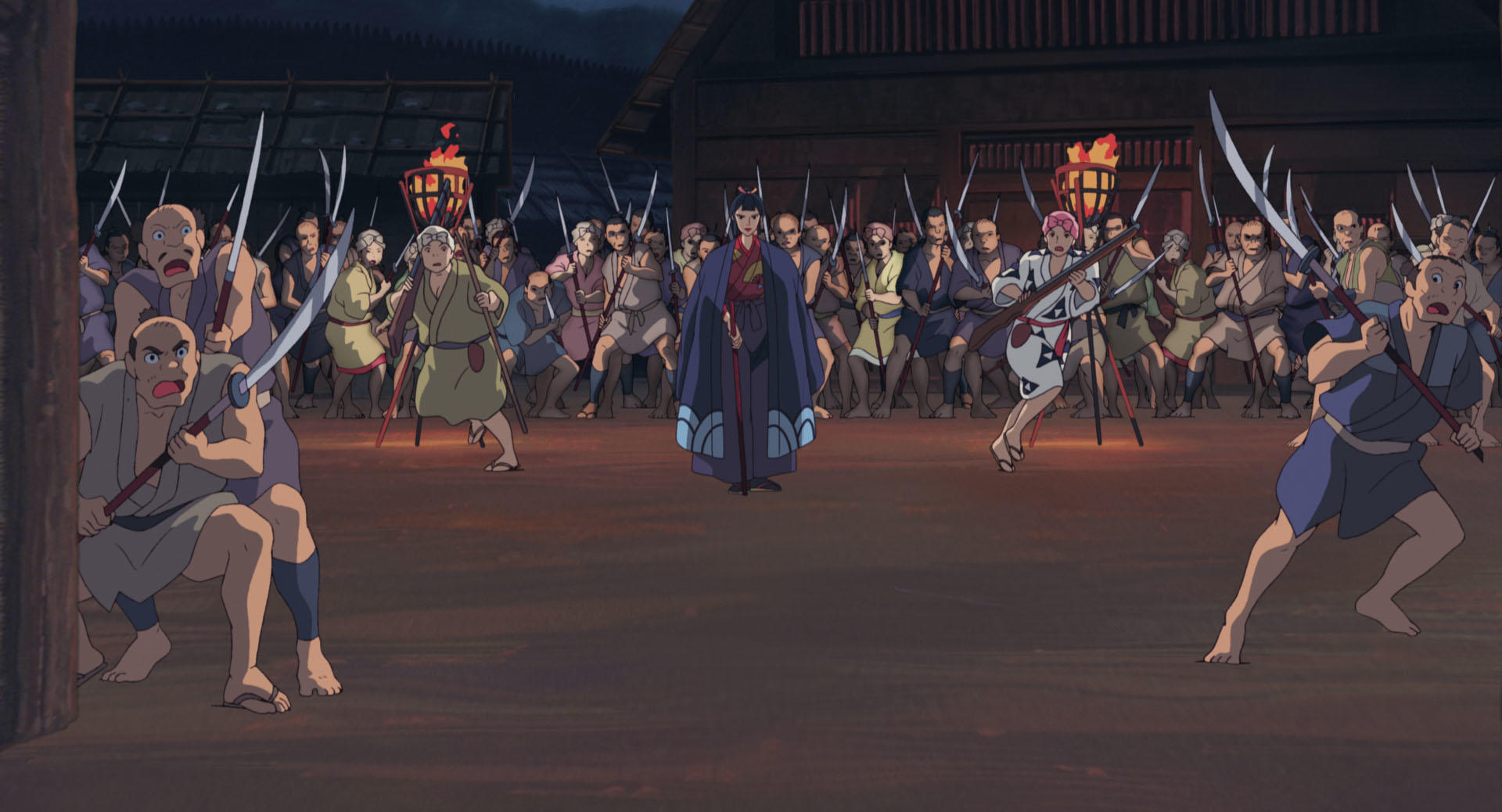
More ambitious landscapes, more unique creature designs, bigger crowd scenes, wider scope, deeper darker politics, and a classic underwhelming ending to round it all out. That’s right, the climax turns into this overly long disaster sequence that—while well animated and even quite tense!—just ruins the pacing. Without that sequence I think this would easily be the greatest animated film of all time. But I find myself saying that about Miyazaki’s endings quite often, don’t I? No wonder he wanted to retire after this one, it looked exhausting to make.
 2. The Castle of Cagliostro
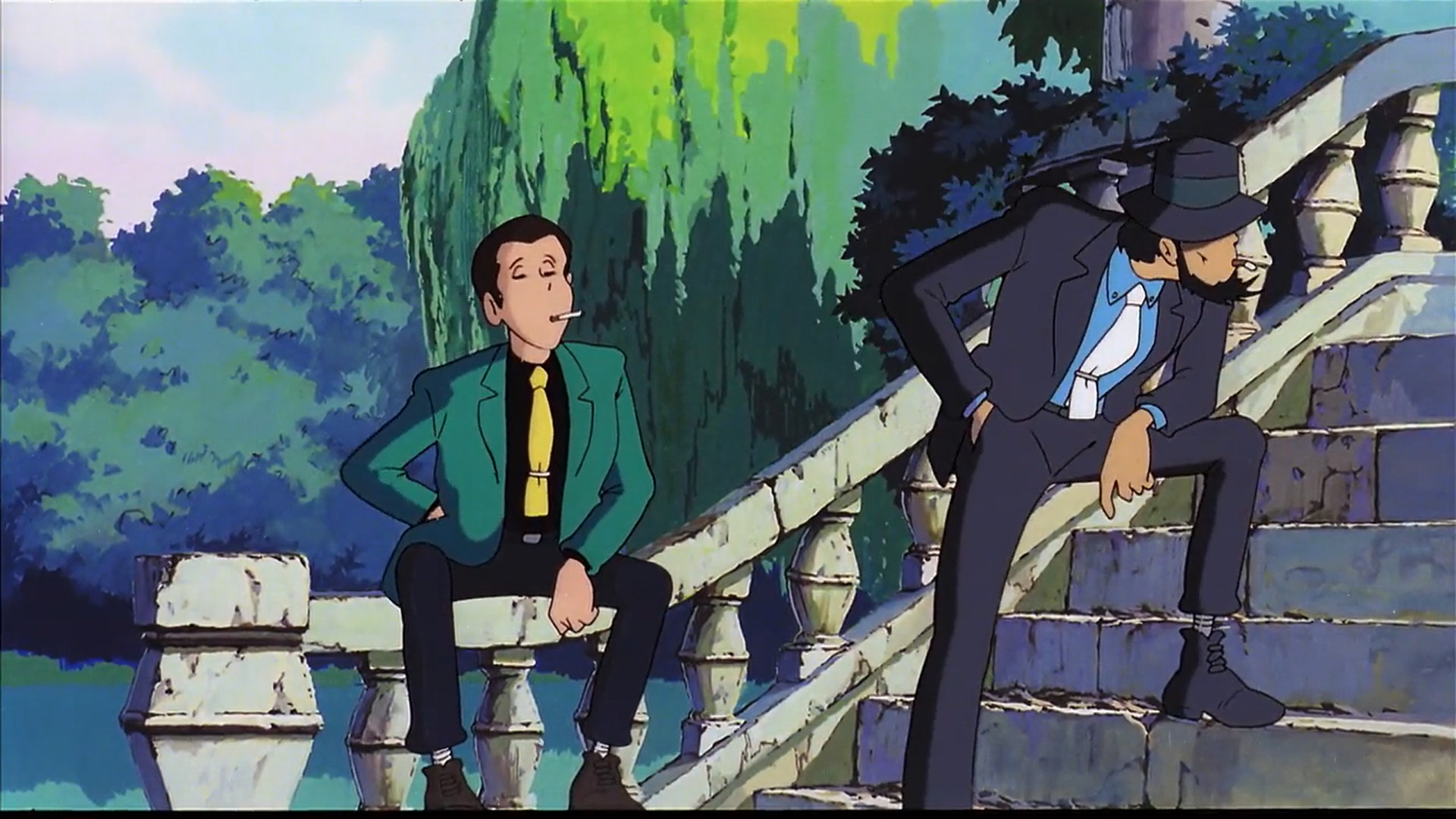
Miyazaki’s feature-length debut is the least “Miyazaki” film by a long shot. The characters are all adults, the women are tropey, the visual style is quite different, there are no fantastical elements, no Joe Hisashi, no message about living in harmony with nature or pacifism or winning over your enemies with love and kindness or whatever. Our protagonist is a lovable gun-toting cigarette-smoking scoundrel from a long-running franchise, sort of Japan’s version of Indiana Jones: a thief named Lupin III, called such because he is descended from gentleman thief Arsène Lupin, who is like a lawless and French (but I repeat myself) version of Sherlock Holmes.
After a successful casino robbery leaves him with nothing but counterfeit cash, Lupin resolves to travel to the rumored capital of counterfeiting: the tiny Central European duchy of Cagliostro, seated in an ancient castle. The regent—a comically nefarious count who doesn’t know how to fully open his mouth when he talks—has a plan to forcibly marry the recently of-age heiress to secure his power and gain access to the secret treasure of Cagliostro that can only be uncovered by joining the signet rings of their two houses. Lupin of course falls in love with the princess and schemes to rescue her, deny the count access to the treasure, and expose the count’s criminal activity to the Interpol officers that are chasing Lupin. He is assisted by femme fatale Fujiko, his irreverent partner-in-crime Jigen, the stoic samurai Goemon, and his nemesis Detective Zenigata.
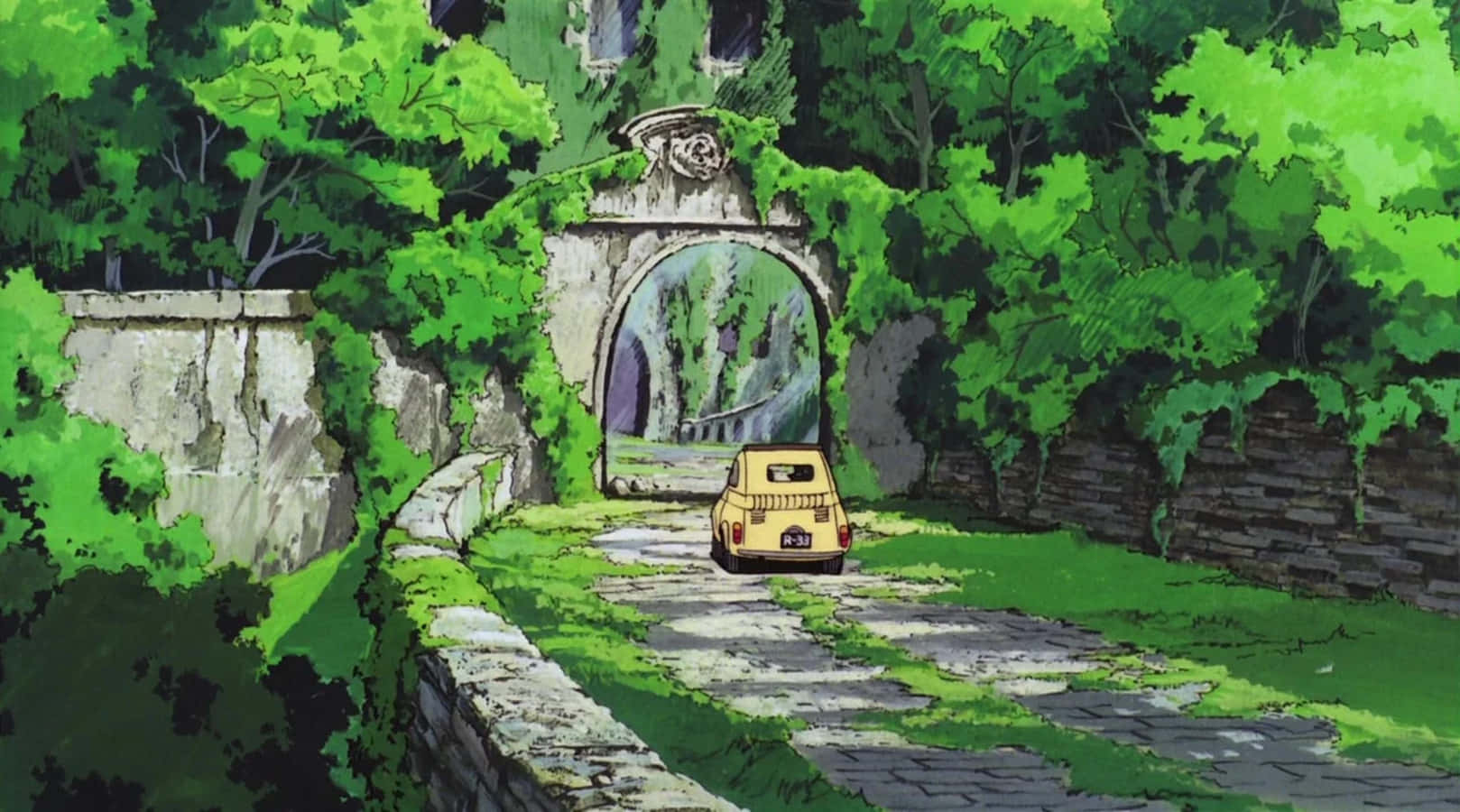
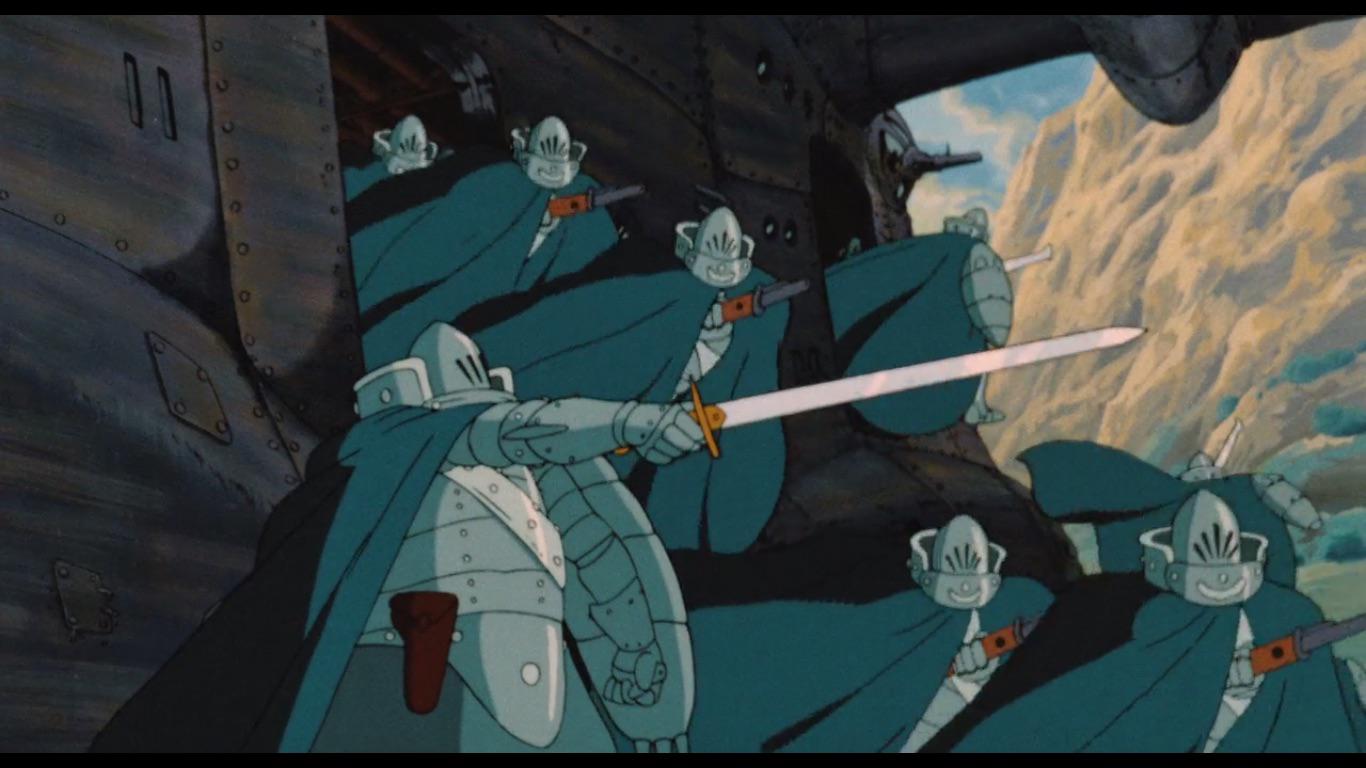
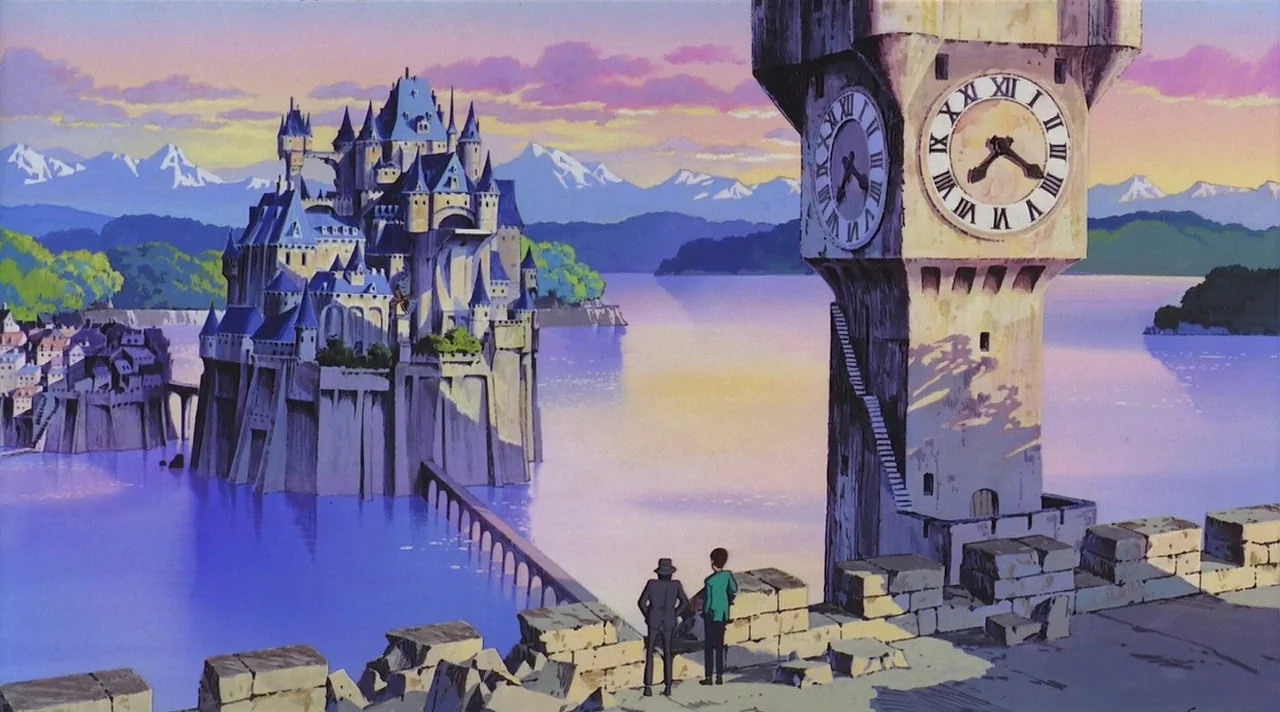
Cagliostro is a gorgeous Arcadian paradise. Overgrown ancient stonework is the flavor of the day, quite reminiscent of Castle in the Sky. There are strange gothic contraptions and futuristic suits of armor that also look straight out of Laputa. This setting lends itself well to a dark mysterious vibe between the more light hearted action sequences. A trapdoor in the grand hallway casts Lupin down to the hellish depths of the castle’s catacombs, where he fends off demonic armored assassins while chest-deep in water. The puzzlebox plot unravels with perfect precision, leading artfully from one mystery to the next. Who is that runaway bride being chased by thugs down the highway? What history does Lupin have with this place? What are these bulletproof simian creatures that pursue them? What mysteries and traps does the castle hold? What is the treasure that the count seeks? By the end you have all your answers, and the exhilaration of multiple masterfully choreographed yet unhinged action setpieces involving helicopters and katanas and sniper rifles and film crews and riot police and dizzying jumps and falls.
John Lasseter says this film began his lifelong love affair with Miyazaki’s work. He specifically mentions the camera, which swoops and dives in ways you didn’t think 2d animation could possibly achieve. It is quite a tour de force of artistic prowess, all for the sort of adaptation you’d usually expect to be confused and phoned in. If you watch some other Lupin works you’ll be surprised how much Miyazaki’s fingerprints are on this dark franchise: Lupin’s ruthless antiheroics are replaced by goofy kindness, Fujiko is desexualized, etc. It’s an ur-text for the upcoming Ghibli, showing the kernel of what would soon set them apart.
I love everything about this film. Instead of the dulcet tones of Joe Hisaishi’s piano we have Yuji Ohno’s funky toe-tapping jazz fusion that was already in the process of mixing with the pop ballad to produce everyone’s favorite overseas musical phenomenon from the 80s: City Pop! The soundtrack is just perfect, veering from groovy and assured to bizarre and experimental, it is no wonder Ohno has become synonymous with the broader Lupin franchise. The characters are richly realized, the art is gorgeous as always (though a little different than the standard Ghibli style we have come to love), the action and sound design are gripping. It may be surprising and even a little unappealing to a devotee of Miyazaki’s, but if you open your heart you’ll find room for Lupin’s crooked smile and the old world beauty of the Duchy of Cagliostro.5
 1. The Wind Rises
You may have noticed that I love to analyze Ghibli films in dialogue with one another, especially in pairs. Mononoke and Nausicaä. Spirited Away and The Boy and the Heron. Totoro and Ponyo. Well here we are at yet another unmistakable siblinghood: Porco Rosso and The Wind Rises. Both are stories about deadpan plane guys watching their nation fall to fascism and their beautiful obsession profaned as a weapon of war. Both contain a lot of Italian aesthetics, especially the soundtracks. Both have a procession of pilots flying to heaven, though The Wind Rises’ WWII pilot heaven looks a lot more crowded!
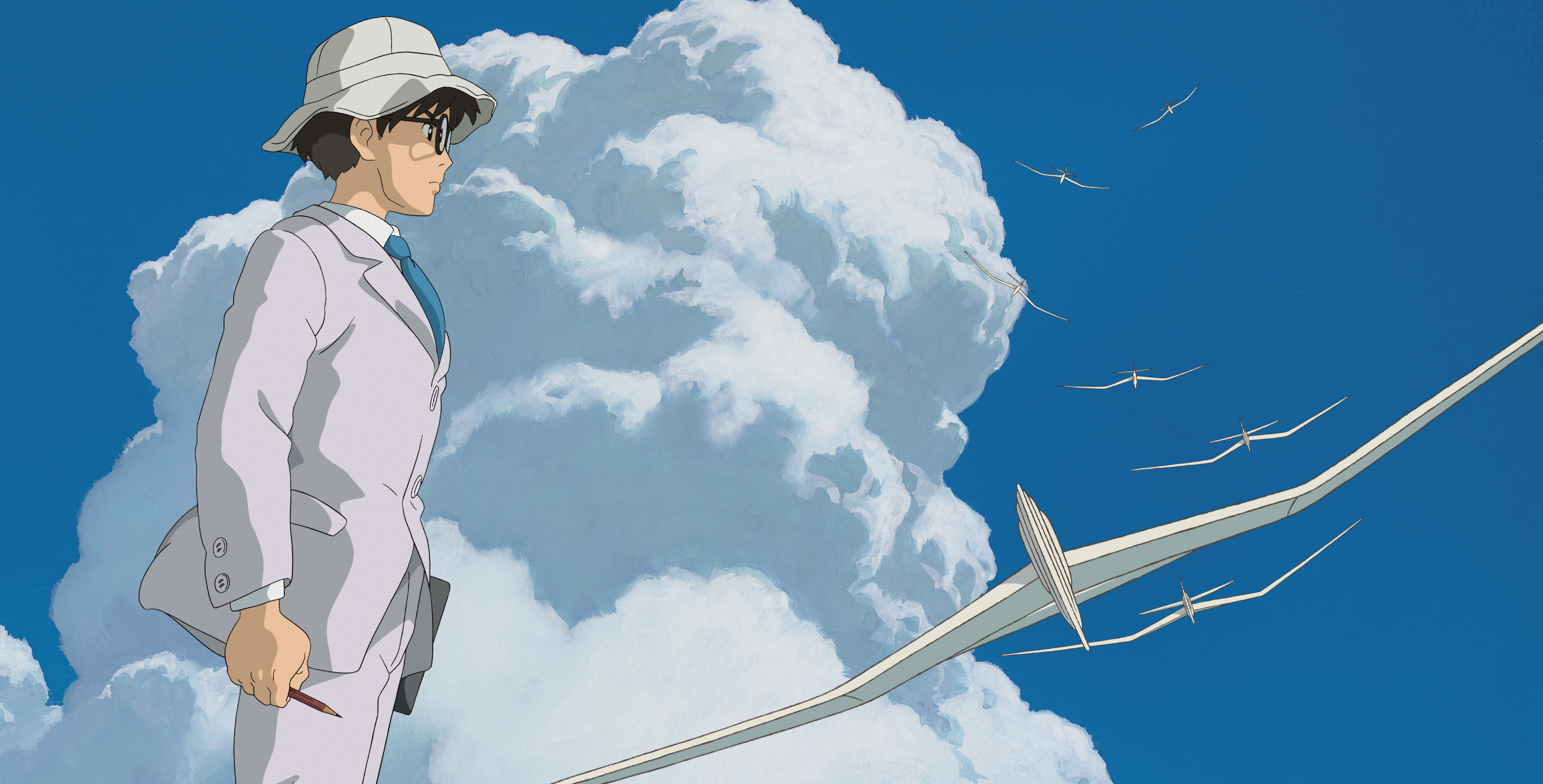
Jiro has been fixated on planes and flying since he was a boy. They fill his dreams, and his dreams intrude on his waking life. He is on a train when the massive 1923 earthquake destroys Tokyo, and he selflessly saves a young girl and her maidservant. After graduating from university and joining a prestigious aviation engineering firm, he juggles the intensity of designing the infamous Zero carrier-based fighter prototype alongside a romance with the girl he saved from the train all those years back, even though she is terribly ill.
A lot of people were upset that Miyazaki’s supposed final film (heard that before!) didn’t feature any outright fantastical elements, opting instead for a somber historical narrative. I’m a big fan of history and of this period in particular, the time of the Japanese inferiority complex, the birth of their renowned engineering culture, and the disastrous cost they paid to prove their mettle to the world. Remember when Christopher Nolan did historical films like Dunkirk and Oppenheimer and he still managed to turn them into twisty nonlinear puzzleboxes equally as formidable as Inception or The Prestige? Miyazaki has done the same here, inundating Jiro’s biography with his phantasmic eye, using the power of animation to completely blur the line between dreams and reality, to step inside the mind of the genius. Speaking of Oppenheimer, there are more comparisons to be had: they are both highly gifted peace-loving men, suspected by their own overbearing governments, plagued by apocalyptic visions of their inventions wreaking destruction. There’s a crazy line where one of Jiro’s apparitions tells him: “Artists are only creative for ten years.” How could Miyazaki possibly let a character say such a thing unchallenged? Does he really believe only one out of his six legendary decades of work is sufficiently unique? And which one is it? The one that includes Mononoke? The one that includes Spirited Away and Howl? The one that includes Kiki and Totoro? The one that includes The Wind Rises?
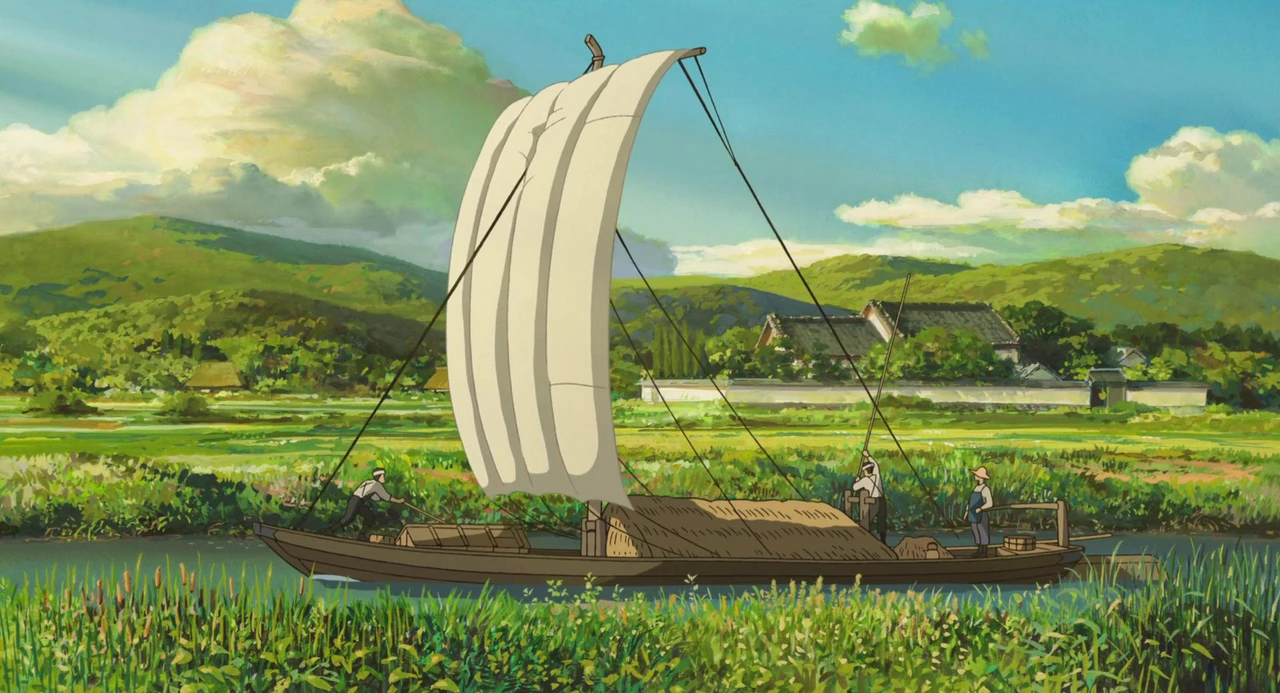
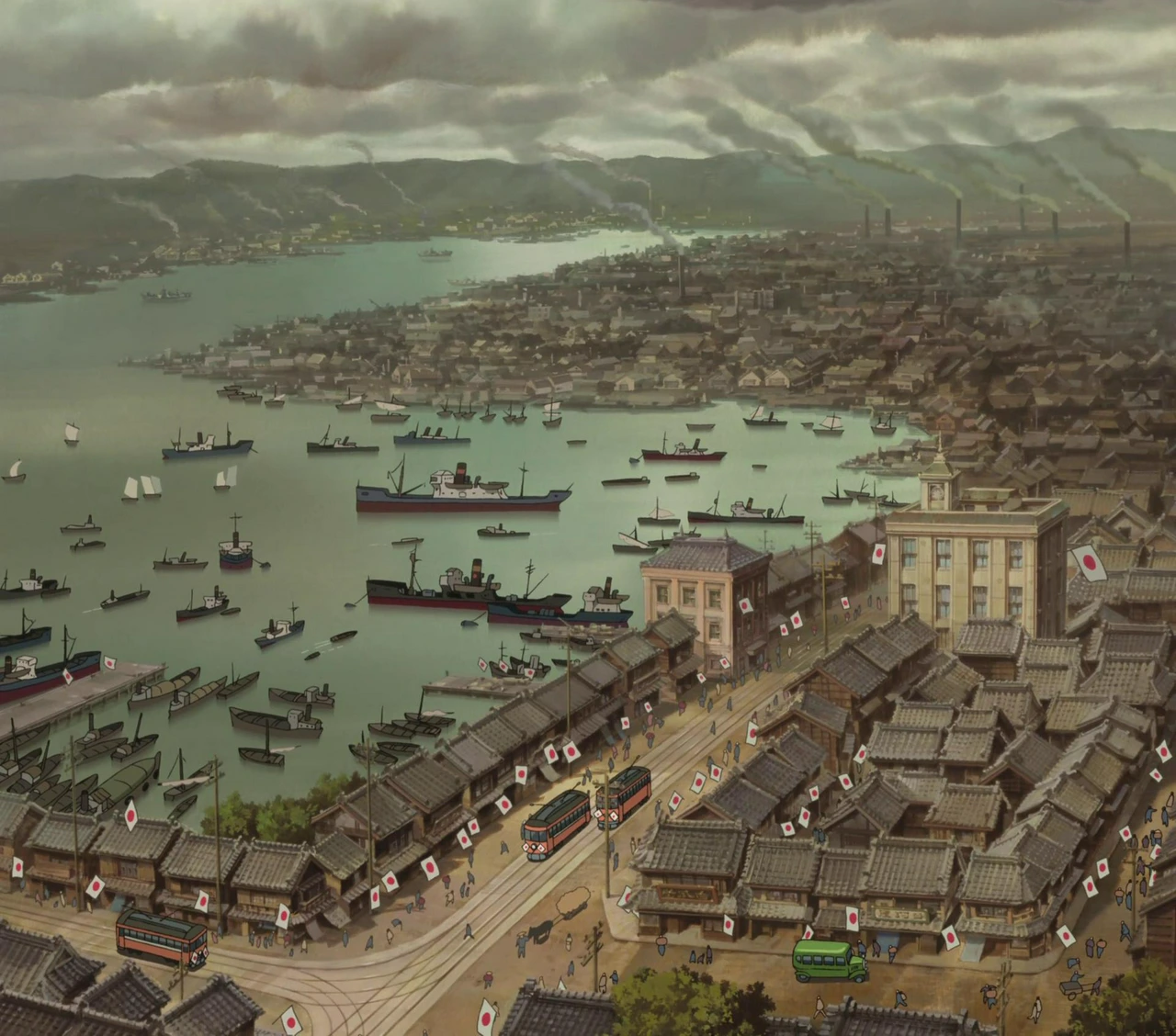
This is Ghibli at its most maximalist. If you love Ghibli’s crowd shots, look no further. The highest number of crowd scenes, the biggest crowds yet, the most detailed per-character design. The intricate detail and massive scale with which Tokyo is portrayed both before and after the earthquake—for fairly fleeting sequences!—is unbelievable. The only films that have ever attempted such scale are Spirited Away’s bathhouse and Mononoke‘s Irontown, but The Wind Rises still holds the crown. If you love Ghibli’s scenery and set design, look no further. The most intricate sets, with perfect historical fidelity, and so many of them! The first half of the film moves rapidly through time and space like a montage, hopping from Nagoya to Tokyo to Germany to a dreamscape of windswept hills, astride literal planes trains and automobiles. It has all the makings of a historical epic: epic scale and scope, dark omens of the past and future. And then it pulls a Castle in the Sky and switches genres midway through, to a sweet romance. And then it switches genres again in the third act, to a tearjerking tragedy. A romsob. Maximalist even in its genre ambitions!
Though the weird Italian soundtrack is a bit off-putting for this thoroughly Japanese story, and the plot is probably confusing to anyone who doesn’t have some familiarity with the history of prewar Japan, and the whole thing is a huge downer, it’s still a triumphant masterpiece and would’ve made a fine swan song in a world where Miyazaki never came back to make The Boy and the Heron. Also, this is the first and only Miyazaki protagonist that wears glasses, and that means he’s cool. Joseph Gordon-Levitt made him sound a little too cool imo, we needed someone who could really bring out the stoic autism6.
Takeaways
Phew, that was a lot more work than I thought! I’ve been laboring over this for the better part of the last month. I have to say, swapping out your standard media diet for a parade of Ghibli films is a bit like a juice cleanse for the soul. I feel a lot more optimistic about the value of art and the kindness of humanity and the possibility for me to have transcendent experiences via media in the future. I also feel like I enjoyed this broad overview of a creator’s lifetime output and might do it again for someone else with a particularly distinct voice.
Now that I’ve seen it all together, there are countless throughlines that emerge. Besides the ones I enumerated in the two eras, I also see:
- Children who are brave and resourceful and kind discovering that a hostile and scary world will soften toward them when they are soft toward it
- Absentee fathers and imperiled mothers
- The flaws of Japan’s society contrasted with the unmistakable beauty of Japan’s nature
- Trees, grass, tears, wind, blood, water, bread
- Glorious flying machines
- Crowds of people/animals/spirits reacting in panic or shock to something
- The looming threat of fascism and the futility of war
- Lame, confusing, overdrawn or overly rushed endings
- Large swarms of cute & tiny creatures (Kodama, mini-Ponyos, soot sprites, Warawara…)
- Moments of stillness. Explosions of motion
- Castles, ruins, abandoned places
- Women who are strong because of their compassion and determination
I highly recommend any fan of animation, storytelling, or humanity watch all 12 of these films. He’s simply the best to ever do it.
1.
I am well acquainted with the standard arguments against auteurship. Miyazaki is so synonymous with Ghibli that they might even be stronger in his case. I think critics of auteurship have proven a mild point (it’s impossible to completely disentangle an auteur from the contributions of their team) and then tend to motte-and-bailey it to a much broader and flimsier claim (auteurship is a totally useless lens for critique). If you are paying attention you can tell when you’re watching Miyazaki and when you’re watching Takahata, or Goro, or one of the other guys. Their tastes and strengths and weaknesses are quite distinctive. ↩
2.
Roger Ebert strongly disagrees. ↩
3.
I suppose there’s some important historical context here: My Neighbor Totoro, the sweetest cartoon of all time, was released as a double bill with Takahata’s Grave of the Fireflies, the saddest cartoon of all time. If you want to analyze it as specifically in conversation with Grave, then some of Totoro‘s decisions suddenly make more sense as an optimistic counterpoint to Grave‘s themes. But I’m not sure that’s what really happened, and in any case most Totoro superfans probably haven’t seen Grave. ↩
4.
Yes I saw the final shot that implies that he finally got together with Gina. That might have worked better if their relationship had half the depth and development that his fatherly bond with Fio did, but since (at least by runtime) Fio seems to be the main focus of the film it’s frustrating that we don’t get any indication whether he was present in her life ever again. ↩
5.
By the way, the Manga Entertainment Dub is wayyyyy better than the Streamline one imo. Lupin is just a little too goofy in Streamline. Manga however has a bunch of curse words in it, so if that bothers you then you can search for the Dicotek remix of the Manga dub, which sneakily edits out all the swears. Neat! ↩
6.
Like the Japanese voice actor, Hideaki Anno! That’s right, the same guy that made Evangelion and also animated all of the grotesque Evangelionesque flesh-melting you see at the end of Nausicaä. ↩